Selling a House As Is in Texas: What It Actually Costs
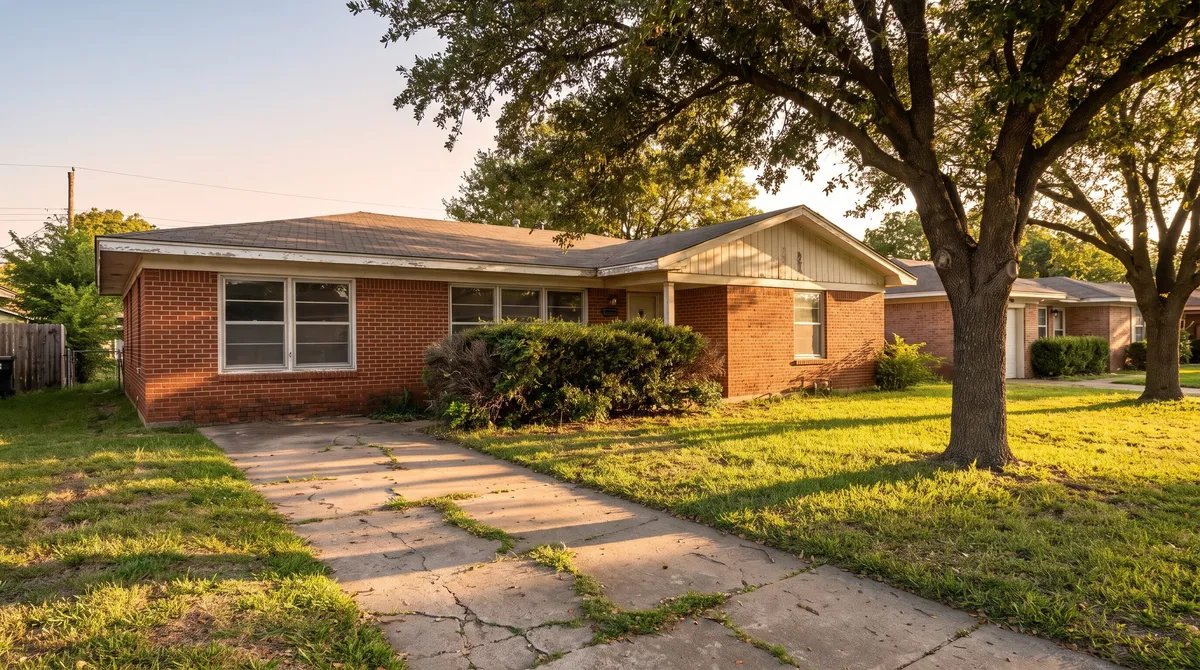
Most sellers asking this question get told they will lose 10% to 20% of their sale price. That range is not wrong, exactly, but it is answering a question you may not be asking, because “as-is” describes two completely different transactions and the discount is not remotely the same.
Listing your house on the MLS and declining to make repairs typically costs 5% to 15% against what the same house would fetch prepped. Selling directly to a cash investor typically costs 10% to 40% below market value. On Fort Worth’s median that is the difference between a $16,000 concession and a $128,000 one. Working out which of the two you are actually considering is the whole decision.
How the numbers in this guide work. Every dollar example is anchored to Fort Worth’s $319,999 median sale price for May 2026, along with the 29 median days on market and the 95.0% sale-to-list ratio, all from my market report. Investor discount ranges are anchored to ATTOM’s Q1 2026 home flipping report, which puts the typical national gross flipping return at 25.4% of what the flipper paid, and to what I see offered in Tarrant County; treat them as estimates rather than published rates. Prep-cost ranges are what I actually see here. Every percentage below names what it is measured against.
Two Things “As Is” Means
The phrase does a lot of work in real estate, and the two meanings behave nothing alike.
As-is on the MLS. Your house is listed publicly, marketed normally, and priced against real comparable sales. You state up front that you are not making repairs. Buyers still inspect, still finance, still appraise. You keep retail pricing and you give up the negotiating room that a prepped, inspected house buys you. In Fort Worth today, with active inventory up 18.4% year over year and 12% of listings taking a price cut, that room is worth more than it was 2 years ago.
As-is to a cash buyer. An investor, a flipper, or an iBuyer buys the house directly. No showings, no inspection contingency, no financing, and a closing you can put on a calendar 7 to 14 days out. You are selling certainty and speed, and the price reflects it. Fix-and-flip buyers work backward from after-repair value. ATTOM’s first-quarter 2026 numbers put the typical national gross return at 25.4% of the purchase price, which means the average flip is bought at roughly 80% of what it later resells for; the 70%-of-after-repair-value rule investors quote is the number they open at, not the number they end up at. iBuyers price closer to comparable sales and then subtract a service fee the major operators publish at around 5% of the sale price, plus repair deductions after their own walkthrough.
The reason the SERP on this question is so muddled is that most of it is written by companies that buy houses, and they have a reason to describe the second transaction using the first one’s numbers.
What Texas Law Still Requires
This is the part sellers get wrong most often, and it is the part with actual liability attached.
An as-is clause does not waive your Seller’s Disclosure Notice. Texas Property Code Section 5.008 requires a written notice on the sale of residential real property of not more than one dwelling unit, and the TREC form is the standard instrument. The notice is a statement of what you know about the property’s condition as of the date you sign it. It is not a warranty, and it is not a substitute for the buyer’s inspection.
The distinction that matters: as-is limits what you agree to fix. Disclosure governs what you have to say. Selling as-is and failing to disclose a known slab issue is not a hard bargain, it is a misrepresentation claim, and Texas courts have been clear that the obligation sits with the seller rather than with the seller’s agent.
A few practical notes. The notice should reach the buyer on or before the contract’s effective date. Once signed, you are not required to update it. There are narrow statutory exemptions under Section 5.008(e), including certain foreclosure, estate, and court-ordered transfers, and vacant land is outside the requirement entirely, but none of those describe an ordinary homeowner selling a house they lived in.
Your buyer also still has an option period, commonly 7 to 10 days, during which they can terminate for any reason at all. As-is does not shorten it. What that means in practice is that undisclosed problems do not disappear, they relocate: the buyer’s inspector finds them in week one and you negotiate under a deadline instead of on your own schedule.
The Arithmetic
Here is the same house four ways, on Fort Worth’s $319,999 median. Total transaction costs on a listed sale run 8% to 12% of the sale price, including commission, the owner’s title policy, tax prorations, and buyer concessions. The table below uses 9%, near the low end of that range, which is about what the sale costs when the buyer asks for no concessions. Add 1 to 3 points of the sale price if yours does.
| Path | Gross price | Costs and prep | Approximate net |
|---|---|---|---|
| Listed, prepped, prep paid by you | $319,999 | 9% costs plus $7,500 prep | $283,699 |
| Listed, prepped, prep paid by me | $319,999 | 9% costs, $0 prep | $291,199 |
| Listed as-is, 8% under comparable value | $294,399 | 9% costs, $0 prep | $267,903 |
| Cash investor at 80% of value | $255,999 | $0 | $255,999 |
The investor column looks better than it should at first glance, because zero costs against zero commission is genuinely attractive. Run it out anyway. The gap between a prepped listing with prep covered and an 80% cash offer is $35,200 on a median-priced Fort Worth house. At 75% of value, which is where flippers most often open, the gap is $51,200.
Local conditions push that the wrong way for sellers right now. ATTOM put the typical gross flipping margin in the Dallas metro at 4.3% in the first quarter of 2026, the second thinnest of any U.S. metro over a million people, behind only Austin. An investor working on that margin has no room to be generous, which is why the cash offers I see in Tarrant County cluster at the bottom of the range rather than the top.
Set the discount against the commission you avoid and it stops being close. Total commission at the Texas average of 5.6% to 5.85% of the sale price runs $17,920 to $18,720 on this house. A 20% discount off market value is $64,000. The discount is roughly three and a half times the commission it is supposed to save you.
And set it against prep, which is the comparison the whole question turns on:
| Discount off market value | Dollars given up | Typical prep cost to avoid it |
|---|---|---|
| 5% | $16,000 | $5,000 to $10,000 |
| 10% | $32,000 | $5,000 to $10,000 |
| 15% | $48,000 | $5,000 to $10,000 |
| 20% | $64,000 | $5,000 to $10,000 |
| 30% | $96,000 | $5,000 to $10,000 |
| 40% | $128,000 | $5,000 to $10,000 |
Cleaning, paint, yard work, minor repairs, staging, and a pre-listing home inspection at roughly $600 once the standard add-ons are included, on a base fee of $390 to $500 for a 2,000-to-4,000-square-foot house, all land in that $5,000 to $10,000 band on a typical Fort Worth home. Even at the mildest discount on the table, prep is the cheaper side of the trade by a wide margin.
When As-Is Is Genuinely the Right Call
I list houses for a living and I still tell sellers to take the cash offer sometimes. The cases where it is correct are specific.
The repair is bigger than the discount. Extensive foundation piering in North Texas clay runs $20,000 to $30,000, and serious structural or septic problems can exceed what prep would ever recover. If the fix costs more than the haircut, sell the problem.
You cannot physically get to the property. Inherited houses, out-of-state owners, and estates in probate frequently cannot be prepped at all. Nobody can coordinate a painter from nine hundred miles away, and there is no discount for good intentions.
Your deadline is days, not weeks. A relocation with a hard report date, a divorce decree with a deadline, or a foreclosure timeline can make 7-to-14-day certainty worth real money. Speed is a legitimate product and investors sell it.
The house is not habitable. Fire damage, hoarding conditions, or major systems failures put a property outside conventional financing entirely, which means the buyer pool is cash regardless of how you list it.
You will not tolerate showings. Some sellers genuinely will not live through 4 weeks of strangers walking the house. That is a real preference and it is allowed to cost money.
What is not on that list: a house that is simply dated. Dated is a prep project, not an as-is case. Original 1978 kitchens sell fine in Fort Worth when the roof is sound and the disclosure is clean.
Who Pays for Prep Is the Actual Question
Most sellers choosing as-is are not choosing it because they ran the arithmetic and preferred the discount. They are choosing it because they do not have $7,500 sitting available to spend on a house they are leaving, and no agent has offered to solve that.
That is the reason I pay for it. Cleaning, repairs, yard work, and staging are on me, before the listing goes live, so you write zero checks before the sign goes up. I also cover the pre-listing inspection out of my own pocket, roughly $600 on a typical Fort Worth home once the standard add-ons are included, which is the single highest-return item on the list, because knowing what a buyer’s inspector will find lets you fix it once on your schedule instead of negotiating it twice under a deadline.
The rest of the written guarantees exist to remove the other reasons sellers reach for a quick cash exit. There is no six-month listing lock-in; send me a text and the representation ends that day. I write a timeline target down before we start, and if I miss it I pay the gap out of my commission at closing. There is a $500 moving credit when you close. And if I am ever late, dishonest, or drop a ball on a commitment, I send you $100 on the spot.
If you want the full sequence rather than just the money question, the seven-step process covers pricing, prep, and launch in order, and the closing cost breakdown shows exactly which line items hit a Texas seller.
Get the Number Before You Take the Discount
The honest version of this decision needs two numbers side by side: what the house would net prepped, and what the cash offer nets today. Almost nobody selling as-is has ever seen the first number.
Book a free 10-minute Initial Consultation and I will build you both. If the cash offer wins on your specific house, I will tell you so and you can go take it. If it does not, you will know what the discount was going to cost you, and prep will not be the thing standing in the way. If the call wastes your time I will send you $100.
If you would rather hear it from my past sellers first, ask for the list. They publish their phone numbers.
Frequently Asked Questions
How much do you lose selling a house as is in Texas?
It depends entirely on which kind of as-is sale you mean. Listing on the MLS without doing repairs typically costs 5% to 15% against what the same house would fetch prepped. Selling to a cash investor or a we-buy-houses operator typically costs 10% to 40% below market value, with most offers landing at 70% to 85% of market value. On Fort Worth's $319,999 median that spread is $16,000 at the low end and $128,000 at the high end.
Do I still have to fill out a seller's disclosure if I sell as is in Texas?
Yes. Texas Property Code Section 5.008 requires a written Seller's Disclosure Notice on any residential sale of a single dwelling unit, and an as-is clause does not remove it. The notice reports what you actually know about the property's condition. As-is limits your obligation to repair what the buyer finds; it does not limit your obligation to disclose what you already know.
Is it worth fixing up a house before selling it in Fort Worth?
In most cases yes, because the arithmetic is not close. Prep on a typical Fort Worth home runs $5,000 to $10,000 against an as-is discount that starts at $16,000 on the median and climbs from there. The exceptions are real: an inherited property you cannot access, a foundation or structural problem larger than the discount, or a deadline measured in days rather than weeks.
How fast can you sell a house as is in Texas?
A cash investor can close in 7 to 14 days because there is no lender, no appraisal, and no financing contingency. A conventional as-is sale on the MLS still takes the normal timeline, which is 29 median days on market in Tarrant County plus 30 to 45 days to close. Speed is what you are actually buying with an investor discount, so it is only worth paying for if you genuinely need it.
Do I pay commission on an as-is sale?
On an MLS listing, yes, the same as any other sale. On a direct investor sale there is usually no listing commission, but the below-market offer captures far more than a commission would have. On a $319,999 home, total commission at the Texas average of 5.6% to 5.85% of the sale price is $17,920 to $18,720, while a 20% discount off market value is $64,000.
Can I sell as is and still get a good price?
Sometimes. A structurally sound but cosmetically dated home in a strong Fort Worth pocket can list as-is and sell near comparable value, especially with active inventory up 18.4% year over year and buyers willing to negotiate on condition. What kills as-is pricing is deferred maintenance a buyer's inspector will find anyway, because the price gets negotiated down during the option period instead of before the listing.
Related Articles

What Is a Listing Agent? What They Owe You in Texas
A listing agent represents the seller. What the role covers in Texas, what the listing side costs, and the four contract terms worth reading twice.
The Complete Guide to Closing Costs for Sellers in Texas
Discover closing costs for sellers in Texas. Learn what fees to expect, how to save money, and get expert tips. Book your free consultation today!
How Much Are Seller Closing Costs in Texas? Your 2026 Guide
Discover how much are seller closing costs in Texas for 2026. Get a detailed breakdown, local tips, and learn how to save. Book your free consultation!