What Is Earnest Money? A Texas Buyer's Complete Guide
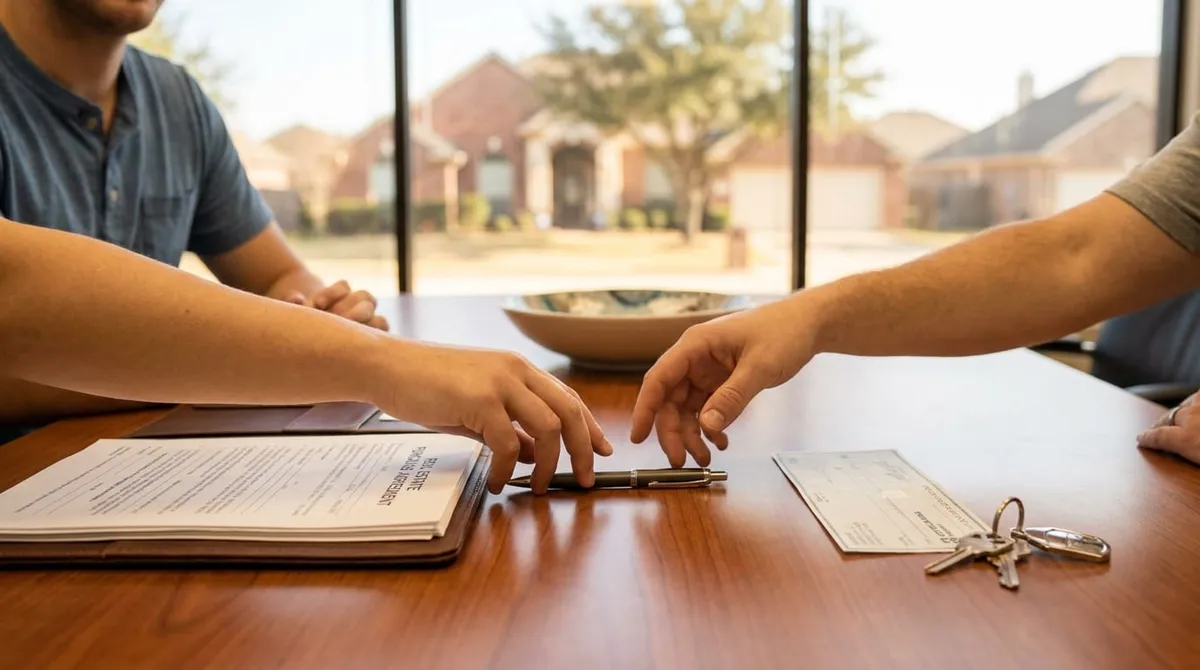
Earnest money is the deposit you hand over when a seller accepts your offer, and in the Dallas–Fort Worth market it usually runs about 1% of the purchase price. On a $400,000 home, that is roughly $4,000 leaving your bank account before you have owned anything, before an inspector has walked the roof, and before your lender has cleared you to close. It sits in a title company escrow account until the deal closes or dies.
Every national article about earnest money tells you the same three things: it is a good-faith deposit, it goes into escrow, and it counts toward your costs at closing. All true. None of it explains the part that actually decides whether Texas buyers keep their money, which is how the option period interacts with the deposit. Texas does this differently than almost every other state, and the buyers who lose deposits here are almost never the ones who found a bad house. They are the ones who missed a date.
Here is what the deposit is, what it costs in DFW, when it is genuinely at risk, and what I do about it for my clients.
What Earnest Money Actually Does
The deposit exists to compensate the seller for taking their house off the market. The moment they sign your contract, they stop showing the property, they stop taking backup offers seriously, and they start planning a move around your closing date. If you disappear three weeks later for no reason, they have lost weeks of market exposure. The earnest money is the agreed price of that risk.
Two things follow from that, and both matter more than the definition:
It is not a fee. The money is yours. At closing it gets credited against your down payment and closing costs, which means it reduces the cashier’s check you bring to the table dollar for dollar. Buyers routinely budget for earnest money as if it were an extra expense on top of everything else. It is not. It is the first installment of money you were already going to spend.
It is not the seller’s money either. Not while the contract is alive. The check goes to the escrow agent named in the contract, almost always a title company, and it stays in their trust account. The seller cannot spend it, and you cannot pull it back on your own. Getting it released takes signatures from both sides.
How Much Earnest Money Do Texas Buyers Put Down?
There is no state-mandated amount. Texas law does not set a floor, a ceiling, or a formula, so the number is a negotiated contract term like the price or the closing date.
What actually happens in DFW:
| Purchase price | Typical earnest money (1%) | Competitive offer (2%) |
|---|---|---|
| $250,000 | $2,500 | $5,000 |
| $350,000 | $3,500 | $7,000 |
| $400,000 | $4,000 | $8,000 |
| $600,000 | $6,000 | $12,000 |
1% is the working default across Tarrant and Dallas counties. On a listing with multiple offers, raising the deposit to 2% is one of the cheapest ways to strengthen your position, because it signals commitment without raising your price. You are not spending more money. You are putting more of the same money into escrow earlier.
Going the other direction is where buyers hurt themselves. A $500 deposit on a $350,000 home reads to the listing agent as a buyer who is either broke or not serious, and it costs you the offer against someone whose numbers look sturdier. If cash is genuinely tight, that is a conversation to have before we write, not a line item to quietly shave.
Earnest Money, Option Fee, and Down Payment Are Three Different Things
This is the section the national articles skip, and it is the reason Texas buyers get confused about whether their deposit is refundable.
Option fee. A separate, smaller payment, commonly $100 to $500 in DFW. Under the TREC forms in use since April 1, 2021, it goes to the title company within three days of the effective date, not to the seller directly. The escrow agent is authorized to release it to the seller without further notice, so the seller still gets it quickly, but the payee on your check is the title company. It buys you the option period: a short window, usually five to ten days, during which you can terminate the contract for any reason at all or for no reason. Bad inspection, cold feet, a better house down the street. Doesn’t matter. The option fee itself is not refundable, but it credits toward your purchase at closing.
Earnest money. The larger deposit held in escrow by the title company. It is not the price of your right to walk. It is the security behind your promise to close.
Down payment. The equity you actually put into the home at closing, typically 3% to 20% of the price. Your earnest money is applied against it, so a $4,000 deposit on a $400,000 purchase with 5% down means $20,000 total down payment, $4,000 of which you already delivered.
The practical consequence: during the option period, your earnest money is fully protected. You can terminate, notify the seller in writing before the deadline, and the deposit comes back. After the option period expires, that unrestricted exit is gone, and your protection comes only from the specific provisions still live in your contract.
When a Texas Buyer Actually Loses Earnest Money
In my experience, deposits are lost for procedural reasons far more often than substantive ones. The four scenarios that account for nearly all of it:
The option period expires while you are still deciding. You get the inspection report on day four, you want a second opinion on the foundation, the roofer cannot come out until next Tuesday, and Tuesday is two days past your deadline. Now you are past your free exit. This is the single most common way it happens, and the fix is boring: extend the option period in writing before it lapses, or schedule the inspection for day one instead of day three.
You miss the financing deadline. The contract’s third-party financing addendum gives you a set number of days to determine whether you can obtain approval. Blow past it without terminating or amending, and you have accepted the financing risk yourself. If the loan then falls apart, the deposit is exposed.
You walk away with no contractual reason. Job change, family situation, a house you like better. Real reasons, all of them, and none of them are contract provisions. After the option period, changing your mind is the definition of buyer default.
You cannot close on the closing date. Wire delays, a last-minute credit inquiry that changes your debt-to-income ratio, a lender who needs one more document. If closing slips and the seller will not sign an amendment extending the date, you are in default on the contract as written.
Notice the pattern. Three of the four are calendar failures. The house is rarely the problem.
Protecting the Deposit
The defense is unglamorous and it works:
- Put every deadline on a calendar the day the contract goes effective. Option period expiration, financing deadline, appraisal timing, closing date. With reminders two days early, not the day of.
- Schedule the inspection for the first available day of the option period, not the last. You want the report with time left to negotiate, re-inspect, or terminate.
- Amend in writing, always. A seller saying “sure, take a few more days” over the phone protects nothing. Deadline changes need a signed amendment.
- Never waive protections to win a bidding war without pricing the risk. Waiving the financing provision on a competitive offer can make sense with the right cash position. It should be a decision you make with the numbers in front of you, not a reflex.
- Deliver the deposit on time. The contract sets a delivery window for the earnest money. Late delivery is itself a breach.
Most of this is the job of your agent, which is the actual point of buyer representation. Deadlines are the part of the transaction where a good agent quietly saves you thousands and you never find out how close it was.
My Earnest Money Guarantee
Here is where I do something no other agent in DFW does.
If you lose your earnest money for any reason during the deal, I write you a personal check to cover the full amount.
Not a credit against my commission. Not a “we’ll work something out.” A check from me, for the full deposit, out of my own pocket. It is Card 2 of my 13 written guarantees, and it is in the agreement I sign before you sign anything.
I offer it for a straightforward reason: nearly every way a buyer loses earnest money in Texas is a deadline or paperwork failure, and deadlines and paperwork are my job. If your deposit gets forfeited, something on my side went wrong. Putting my own money behind that is just carrying the consequence where it belongs.
It also changes how the transaction feels. Buyers who know their deposit is guaranteed make better decisions. They do not rush an inspection to feel safe, they do not waive protections out of anxiety, and they do not talk themselves into a house they have doubts about because they are afraid of losing $4,000 by walking. The guarantee removes the fear from the exact moment when fear makes people make expensive mistakes.
One client put it plainly after we walked from a house where the inspector found a hidden roof issue: the inspection cost was mine, not theirs, and the earnest money came back. They did not lose a dollar.
The guarantee sits alongside the rest of what I cover: the roughly $600 home inspection, a lender-paid appraisal, a $500 moving credit at closing, and $0 buyer commission. If you want to understand how that last one works after the NAR settlement, I break down the commission structure separately. And if you are building a full budget for a purchase, the complete picture of buyer costs covers what actually hits at the closing table.
What To Do Before You Write an Offer
Three things, in order:
Know your number. Decide what you can comfortably put into escrow before you fall in love with a house. On a $400,000 target, plan for $4,000 and be ready to go to $8,000 if the listing draws a crowd.
Confirm where the money goes. The escrow agent is named in the contract. Verify the title company independently before you wire anything, because wire fraud in real estate is real and DFW is a frequent target. Call the number on the title company’s own website, never the one in an email.
Understand your exits before you need one. Ask your agent to walk you through the option period, the financing terms, and the closing date on your specific contract. If they cannot explain in plain language what would cause you to lose the deposit, that is worth knowing before you hand over a check.
Get the Contract Explained Before You Sign It
Earnest money is a small number attached to a large fear, and most of that fear comes from not knowing which deadlines matter. That is a fixable problem, and fixing it takes about ten minutes.
Book a free 10-minute Initial Consultation and I will walk through the Texas option period, what your deposit should be for the price range you are shopping, and exactly where the risk sits in the contract. No pitch, no obligation, and if you decide I am not the right fit, you have still got the information.
If you would rather hear it from someone other than me first, ask for my past client list. They publish their phone numbers, and you are welcome to call them before we ever meet.
Frequently Asked Questions
How much is earnest money on a $400,000 house in Texas?
Around $4,000. The DFW norm is 1% of the purchase price, though it climbs to 2% or 3% on competitive listings where a buyer wants the offer to stand out. There is no legal minimum in Texas. The seller decides what they will accept, and the amount goes into the contract as a negotiated term.
Is $500 enough earnest money?
On a typical DFW home, no. A $500 deposit on a $350,000 house is roughly 0.14% of the price, and most listing agents will read it as a weak offer. Sellers use the deposit size as a signal of how serious you are. If cash is tight, tell me before we write, because there are better places to save money than the one line item the seller is watching.
Is earnest money refundable?
Usually, yes. Inside the Texas option period you can terminate for any reason and the earnest money comes back to you. After the option period, it stays refundable as long as you are protected by a contract provision you have not waived, such as the financing or appraisal terms. You lose it when you walk away with no contractual reason or blow a deadline.
Who holds earnest money in Texas?
The title company, not the seller and not the agent. You deliver the check to the escrow agent named in the contract, and the funds sit in an escrow account until closing or termination. Neither side can touch it unilaterally. Releasing it early takes a signed release from both buyer and seller.
What is the difference between earnest money and the option fee?
The option fee is a smaller, separate payment (commonly $100 to $500 in DFW) that buys you an unrestricted right to terminate during the option period. Under the TREC forms in use since April 1, 2021, you deliver it to the title company within three days of the effective date, and the escrow agent releases it to the seller from there. It is not refundable, though it credits toward your purchase at closing. Earnest money is the larger deposit held in escrow, and you get it back if you terminate properly.
What happens to earnest money if the seller backs out?
You get it back, and you may have further remedies under the contract. A seller who refuses to sign the release is a real scenario, and it turns into a dispute the title company will not resolve on its own. This is where an agent who knows the contract earns their keep, and it is exactly why I put my own money behind the outcome.