Real Estate Commission in Texas: Who Pays What in 2026
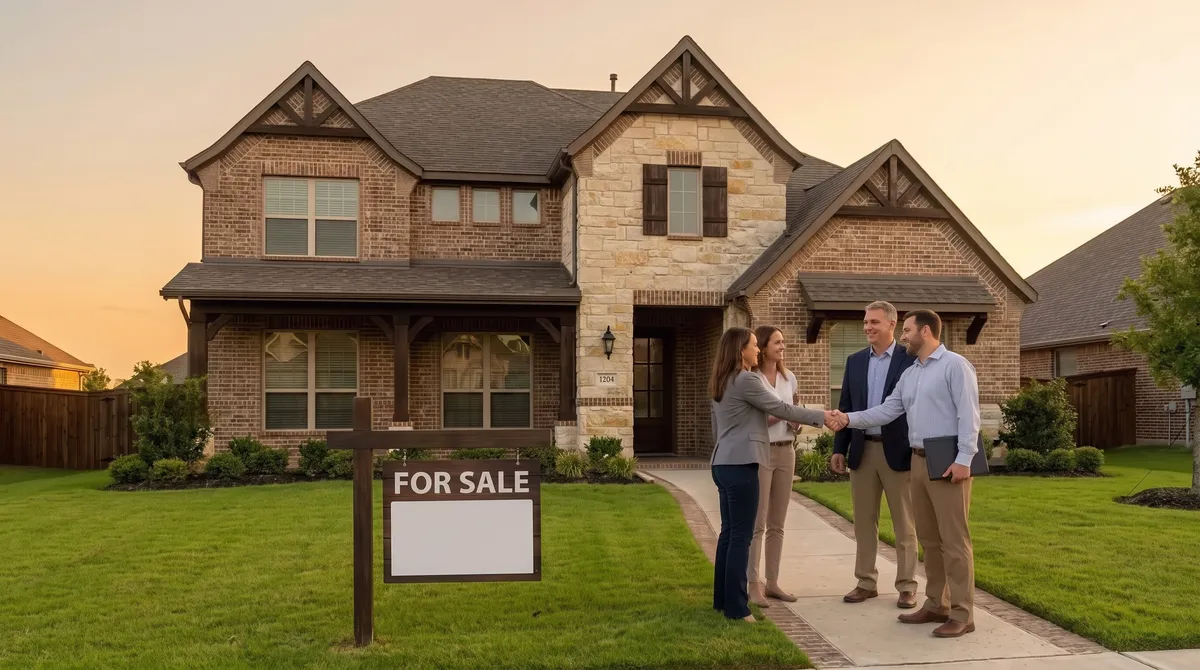
If you searched “real estate commission Texas,” you landed on one of two questions. Either you are looking for the Texas Real Estate Commission, the state agency that licenses agents and takes consumer complaints, or you want to know what agents actually charge here. This article is about the second one.
The short answer: total commission in Texas averages roughly 5.6% to 5.85% of the sale price, usually split between the listing side and the buyer’s side. On a $400,000 Fort Worth home, that is about $23,400 moving across the closing table. No Texas statute sets that number, and federal antitrust law prohibits agents from agreeing among themselves on one, so treat any quoted rate as a market average rather than a standard.
The bigger question, and the one the 2024 settlement made genuinely confusing, is who pays it. Here is how it works now.
What Texas Commission Actually Costs
Commission is charged as a percentage of the final sale price and paid at closing out of the proceeds. The total is typically divided in two: a listing side and a buyer’s side, each landing somewhere between 2.5% and 3%.
Run the math on real DFW price points:
| Sale price | Total at 5.85% | Listing side (~2.925%) | Buyer’s side (~2.925%) |
|---|---|---|---|
| $300,000 | $17,550 | $8,775 | $8,775 |
| $400,000 | $23,400 | $11,700 | $11,700 |
| $500,000 | $29,250 | $14,625 | $14,625 |
| $650,000 | $38,025 | $19,013 | $19,013 |
Two things people get wrong about those numbers:
The agent does not keep their side. The commission is paid to the brokerage, not the individual. The agent’s split with their broker comes first, then self-employment tax, MLS and association dues, marketing spend, insurance, and the cost of every deal that fell apart and paid nothing. An $8,775 side on a $300,000 sale is not $8,775 of income.
Half a point is real money. The gap between 5.5% and 6% on a $450,000 home is $2,250. That is worth a conversation before you sign a listing agreement, which is exactly when the rate is negotiable and exactly when most sellers do not ask.
Who Pays It: Before and After the Settlement
For decades in Texas, the mechanic was simple. The seller signed a listing agreement covering the full commission, the listing broker offered a share of it to whichever broker brought the buyer, and that offer was published in the MLS. Buyers rarely saw a commission line item, because the money came out of the seller’s proceeds.
The National Association of Realtors settlement changed two specific things, effective August 2024:
Offers of compensation came off the MLS. Listing brokers can no longer advertise buyer-agent compensation through the multiple listing service. Compensation still gets negotiated, it just happens through direct communication, seller concessions, or a term in the purchase contract instead of an MLS field.
Written buyer agreements became mandatory. Before touring a home with an agent, a buyer now signs a representation agreement that states, in writing, what that agent will be paid and by whom.
That second change is the source of most of the anxiety I hear. Buyers read headlines about “now buyers have to pay their agent” and assume a new bill just landed on them. In practice, sellers in Texas still fund both sides on the large majority of transactions, because a seller who declines to cover buyer-side compensation shrinks their own buyer pool. What actually changed is that the amount is now written down and agreed to up front instead of being assumed.
What the settlement did not do
Worth stating plainly, because there is a lot of noise:
- It did not cap or set commission rates. Rates were negotiable before and remain negotiable.
- It did not make seller-paid buyer commission illegal. Sellers can still offer concessions and still routinely do.
- It did not automatically reduce anyone’s costs. The average Texas rate did not move much.
- It did not eliminate buyer’s agents. It made their compensation explicit.
The honest summary: the settlement moved a number that used to be invisible into a document you sign before you see your first house. Whether that saves you money depends entirely on what you negotiate.
How the money actually moves at closing
Commission never passes through anyone’s checking account. It comes out of the sale proceeds at the title company.
The escrow officer prepares the settlement statement, deducts the agreed commission from what the seller receives, and disburses it to the brokerages, not to the agents personally. The listing broker is paid under the listing agreement. The buyer’s broker is paid under whatever mechanism the parties negotiated: a seller concession written into the contract, a direct agreement between brokers, or a payment from the buyer if neither of those covers it.
Two practical consequences for buyers. First, if you are financing, any commission you owe personally is generally not something you can roll into the loan. It is cash at closing, on top of your down payment. Second, the moment your compensation is structured as a seller concession, it becomes part of the offer negotiation, which means it competes with your price. A seller weighing two offers is looking at their net, and a $12,000 buyer-side concession makes your $400,000 offer look like a $388,000 offer to them.
That tradeoff is invisible to most buyers and it is where deals get won or lost in the post-settlement market.
Flat-Fee and Discount Brokerages
The obvious response to a five-figure commission is to shop for a cheaper one, and Texas has plenty of options: flat-fee MLS listings for a few hundred dollars, discount brokerages at 1% to 2% on the listing side, and rebate models on the buyer side.
They are legitimate businesses and they work for some sellers. The question to ask is what comes out of the package at that price.
On the listing side, a flat-fee MLS entry gets your home into the system and nothing else. Photography, pricing strategy, pre-inspection, staging, showing coordination, offer negotiation, and inspection-repair negotiation are yours to handle. If you have sold houses before and you have the time, that can pencil out. If you have not, the discount frequently gets eaten by a lower sale price or a longer time on market. Fort Worth’s median days on market sat at 29 in May 2026, and a listing that stalls well past that is another mortgage payment, another tax accrual, and another insurance premium.
On the buyer side, rebate models return a portion of the commission after closing, usually as a credit at the table. That is real money. Read the conditions, because rebates commonly carry minimum purchase prices, exclusions on new construction, and lender restrictions that can shrink or void them.
My position on this is not that cheaper is wrong. It is that the comparison people run is usually incomplete. Compare what you pay against what you get, including the costs someone else absorbs on your behalf, and use net proceeds rather than the headline rate as the measuring stick.
Reading a Buyer Representation Agreement
Since you now sign one before touring, read these four things before you initial anything:
The compensation amount. A percentage, a flat fee, or zero. This is the number you are personally on the hook for if the seller does not cover it.
The source-of-payment language. Most agreements say the agent seeks compensation from the seller or listing broker first, and the buyer covers any shortfall. The size of that potential shortfall is what matters.
The term length. Six-month exclusive agreements are common. If the relationship is not working in week three, you may be stuck with it through month six.
The cancellation terms. Ask directly: can I end this today, in writing, without a fee? Get the answer before you sign, not after.
I mention the last two because they are where buyers get trapped, and they are two of the reasons I run my buyer representation differently. There are no six-month lock-ins on my side. Send me a text and the representation ends that day.
Why My Buyers Pay $0
Card 3 of my written guarantees is one line: buyers never pay me a commission, and if the seller will not cover it, I absorb the difference myself.
That is the whole thing. Not a rebate that shows up later, not a discounted rate, not a “we’ll figure it out at closing.” The buyer agreement I use specifies $0 buyer commission, and the shortfall risk the settlement created for buyers sits on my side of the table instead of yours.
I structured it that way because the alternative is asking a first-time buyer who is already stretching for a down payment to also budget for a five-figure contingency they cannot control. The seller’s willingness to pay buyer-side compensation is not something the buyer decides. Handing them that risk never made sense to me.
What it means in practice on a $400,000 purchase: the buyer-side compensation is negotiated with the seller as part of the offer, the same as it always was. If the seller covers it in full, nothing changes for you. If the seller balks and we still want the house, I take less. Either way your closing statement shows $0 in buyer commission.
It stacks with the rest of what I cover: the roughly $600 home inspection, a lender-paid appraisal, a $500 moving credit at closing, and an earnest money guarantee that puts a personal check behind your deposit if it is ever forfeited. On a $400,000 purchase, the $0 buyer commission alone is worth roughly $11,700, before the inspection and moving credit on top. The full breakdown of buyer costs shows where each of those lands in a real transaction.
What Sellers Pay, and Where It Bends
If you are on the listing side, commission is your largest single closing expense by a wide margin, and it is the one with the most room in it.
Total seller closing costs in Texas generally run 7% to 9% of the sale price. Commission is most of that. The remaining 1% to 3% covers the owner’s title policy, escrow and settlement fees, property tax prorations, HOA transfer fees, and recording, which my seller closing costs breakdown walks through line by line.
Where the commission conversation actually bends:
The listing rate itself. It is a contract term. Negotiate it before you sign, because after that it is fixed for the term of the agreement.
Buyer-side compensation. Post-settlement, this is a separate decision from your listing rate. You can offer more to attract buyers in a slow market or less in a hot one, and the tradeoff is real either way.
What is included. A lower rate that leaves you paying for staging, professional photography, pre-inspection, and repairs is not a lower rate. On my listings, the roughly $600 pre-inspection plus cleaning, repairs, yard work, and staging come out of my pocket, not yours. Compare total out-of-pocket, not the percentage.
The rate on the page is the least interesting number in the conversation. What the agent covers, what they net you, and how long the house sits are the ones that show up in your bank account.
Get Your Actual Number Before You Sign Anything
Averages are useful for orientation and useless for decisions. What matters is your price point, your side of the transaction, and what your agent is actually putting on the table against their fee.
Book a free 10-minute Initial Consultation and I will run the real commission math on your specific situation, walk you through what changed after the settlement and what did not, and show you the written agreement before you commit to anything. Ten minutes, no pitch.
You can also verify my license, and anyone else’s, directly through the Texas Real Estate Commission license search before you take a single word of this on faith. I would rather you check.
Frequently Asked Questions
What percentage do most realtors charge in Texas?
Total commission averages about 5.6% to 5.85% of the sale price statewide, usually divided between the listing side and the buyer's side at roughly 2.5% to 3% each. Texas law sets no rate. Federal antitrust law actually prohibits agents from agreeing on one, so any figure you see quoted is a market average, not a standard.
How much do real estate agents make off a $300,000 house?
At a 5.85% total commission, a $300,000 sale generates about $17,550, or roughly $8,775 per side. The agent does not keep that. It goes to the brokerage first, and the agent's split, plus self-employment taxes, marketing, MLS dues, and transaction costs come out of it before anything reaches their pocket.
Do buyers pay realtor fees in Texas?
Traditionally no, and in most Texas transactions today the seller still funds both sides out of closing proceeds. Since the NAR settlement, buyers sign a written representation agreement that states their agent's compensation, so there is now a defined amount a buyer could owe if the seller does not cover it. In my agreements, that amount is $0.
Did the NAR settlement lower commissions in Texas?
Not by rule. The settlement removed offers of compensation from MLS listings and required written buyer agreements before touring homes. It did not set caps, ban seller-paid buyer commission, or force rates down. What it did was make the number visible and explicitly negotiable earlier in the process.
Is 3% a reasonable realtor fee?
Three percent per side is within the normal Texas range, which is a different question from whether it is worth it on your deal. Judge it against what the agent actually puts on the table. On my side, that includes the roughly $600 inspection, a lender-paid appraisal, a $500 moving credit, and written guarantees backed by my own checkbook.
Can I negotiate real estate commission in Texas?
Yes, on both sides. Listing commission is a contract term you negotiate before signing, and buyer-side compensation is a term in your representation agreement. Anyone who tells you a rate is fixed by law or by the board is wrong. Just weigh the rate against what is being delivered rather than shopping on price alone.
Related Articles
Closing Costs in Fort Worth, Texas: What Buyers Pay
Buyer closing costs in Fort Worth run 3% to 5% of the price. The line items one at a time on the median, who pays what in Texas, and how to cut the number.
Down Payment Assistance in Texas: HAP, TSAHC, TDHCA
Texas down payment assistance is not free money. Most of it is priced into your interest rate. The real math on HAP, TSAHC, and My First Texas Home.

FHA vs. Conventional Loan in Texas: Which Is Better?
FHA or conventional in Texas? Compare 2026 down payments, credit minimums, MIP vs PMI, and Tarrant County loan limits with real Fort Worth payment math.