
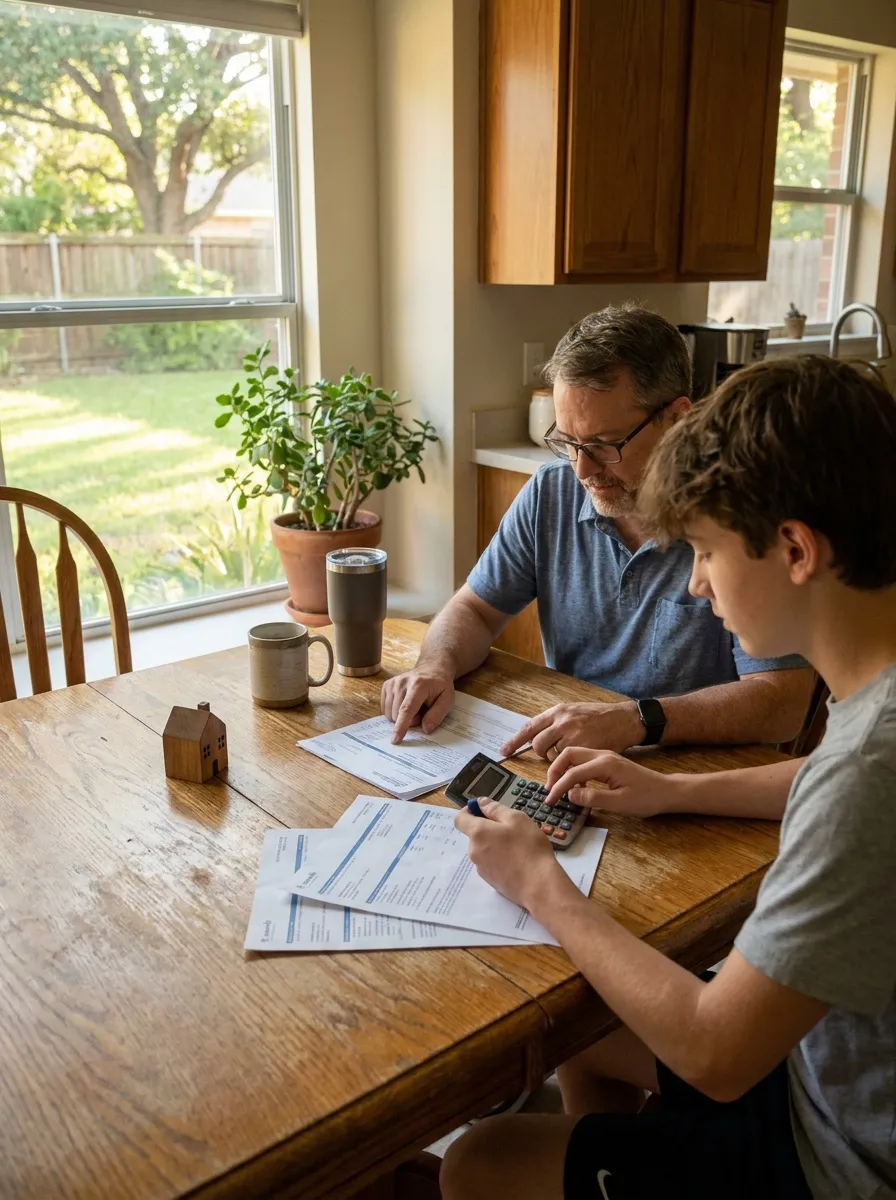
Fort Worth Financing By the Numbers
The four numbers that frame every Fort Worth financing decision in 2026. Loan minimums, the state-tax tailwind, the HUD eligibility window, and the stackable Texas down payment ceiling.
Single-family, current band.
Texas keeps more of your paycheck.
No principal residence in last 3 years.
TSAHC + My First Texas Home.
The Fort Worth Financing Picture
F ort Worth financing math has more moving parts than most buyers expect. The headline number for the Dallas-Fort Worth metro lands between $375,000 and $430,000 for median single-family sales, but the financing decision is set by four numbers: loan type, down payment, Tarrant County property taxes, and assistance eligibility. Get those four right and the day-one cash to close lands in a manageable place. Get one wrong and the offer either falls apart or costs thousands more than it should.
Three numbers run the rest of the math. The loan type you qualify for sets your minimum down payment, anywhere from 0% to 3.5% depending on the program. Texas down payment assistance programs can layer up to 5% on top, with their own eligibility windows. And the state's no-income-tax setup quietly hands you back $5,000 to $6,000 a year compared to California or New York earners at the same gross income, money that funds reserves and closing costs.
Every dollar amount on this page is field-tested, not aspirational. The buyer agreement Conner uses specifies $0 buyer commission, which matters more since the NAR settlement reshaped the commission structure for buyers. Which program you pick matters too, and the FHA versus conventional comparison turns almost entirely on your credit score. Before you pick a program, read what the assistance programs actually cost, because state DPA is priced into your interest rate and the city's HAP is not. The rest of what you owe at the table is itemized in the closing cost breakdown, where prepaids and escrow reserves account for most of the total. The home inspection runs around $600 and Conner covers it. The lender pays the appraisal. The $500 moving credit lands at the closing table. None of that interferes with TSAHC, My First Texas Home, HAP, or any other assistance program. The savings stack.
The Texas Tax Math + Down Payment Assistance Eligibility
Two pieces of math shape Fort Worth financing: the no-state-income-tax setup that quietly funds your reserve account, and the eligibility windows on the Texas down payment assistance programs.
Most Texas down payment assistance programs use the HUD three-year rule for eligibility: you qualify if you have not owned a principal residence in the past three years. That opens the assistance window for plenty of repeat buyers who do not realize they still qualify. A prior home you rented out, a parent's house with your name on it for estate reasons, or any purchase outside the three-year window can all change the eligibility math. Veterans get an exemption from the rule under most Texas programs, including My First Texas Home. The lender conversation is where the program math actually starts.
Texas adds a second piece of math most buyers underrate
No state income tax. A buyer earning $90,000 a year keeps roughly $5,000 to $6,000 more in Texas than in California or New York. That money does not disappear into a state filing every April. It funds the closing cost reserve, the moving budget, the first six months of property tax escrow.
"Most Fort Worth buyers I meet are surprised twice. Once when they see what Tarrant County actually has under $375K. And again when they realize Texas hands them back a paycheck a state filing would have taken."
The trade-off is property taxes. Tarrant County effective rates run 2.3% to 2.6% once you stack city, county, and school district. The Texas homestead exemption blunts that on owner-occupied homes by removing $100,000 from school district appraised value and capping annual appraisal increases at 10%. You file once with the Tarrant Appraisal District in the year you take title, and the savings compound every year you stay in the home.
Four Loan Types, Side By Side
The down payment floor is set by the loan, not the home. Match the loan to your situation first, then pair it with a Texas assistance program if you want to drop the out-of-pocket number further.
Credit floors are program floors. Individual lenders impose overlays that can land 20–60 points higher. The lender match matters as much as the loan type, particularly when assistance programs are in play.
Texas Down Payment Assistance, Stacked
Two state programs do most of the heavy lifting for Fort Worth buyers who qualify. Both pair with FHA, VA, USDA, and conventional loans. Both have income and purchase-price limits set at the county level. Eligibility uses the HUD three-year rule, which catches more repeat buyers than most realize.
TSAHC · Home Sweet Texas
Home Sweet Texas Home Loan
Open to buyers who meet income and purchase-price limits, including repeat buyers outside the HUD three-year window. Provides a 30-year fixed-rate first mortgage plus down payment and closing cost assistance of up to 5% of the loan amount, structured as a grant or forgivable second lien.
- ✓Pairs with FHA, VA, USDA, Conventional
- ✓Tarrant County income limits update annually
- ✓No first-time buyer requirement in targeted areas
TSAHC · Homes for Texas Heroes
Homes for Texas Heroes
The same 30-year fixed-rate loan structure with up to 5% in assistance, reserved for qualifying public servants. The eligibility list is broad, and Tarrant County has hundreds of qualifying buyers in any given month.
- ✓Teachers, paraprofessionals, school employees
- ✓Police, fire, EMS, corrections officers
- ✓Veterans, active-duty military, and nurses
TDHCA · My First Texas Home
My First Texas Home
Run by the Texas Department of Housing and Community Affairs. Offers a 30-year fixed-rate mortgage plus down payment and closing cost help of up to 5% of the loan amount, as a deferred forgivable second lien. Veterans are exempt from the first-time buyer rule.
- ✓HUD three-year first-time buyer rule applies
- ✓Tarrant County income and price limits
- ✓Stackable with FHA, VA, USDA, Conventional
Conner's Five Financing Tips Before You Tour
Five rules every Fort Worth buyer hears on the first call: the financing moves that separate a clean close from a scramble. They cost nothing to follow, and skipping any one of them is what blows up most files between offer and closing.
- 01
Get pre-approved before you tour anything
A pre-approval letter is the bouncer at every Fort Worth showing. Without one, sellers screen you out before the listing agent forwards your offer. A real pre-approval pulls credit, verifies income and assets, and prices your loan options against the down payment programs you actually qualify for.
- 02
Do not touch your credit between pre-approval and closing
New auto loans, store cards, balance transfers, even soft inquiries that turn into hard pulls can sink the file. Lenders re-pull credit days before funding. The cleanest first-time buyer files freeze at pre-approval and stay frozen until the wire hits the title company.
- 03
Budget the full PITI, not just the principal and interest
Principal and interest is one quarter of the conversation. Tarrant County property taxes, homeowners insurance, and HOA dues (when applicable) round it out to the real monthly PITI number. On a $400,000 Fort Worth home, taxes and insurance can add $900 to $1,100 a month on top of the mortgage payment.
- 04
Use the option period the way it was designed
Texas contracts give you a short, paid option period (typically 5 to 10 days) to inspect the home and walk away for any reason without losing earnest money. Schedule the inspection on day one, line up a re-inspection if anything is repaired, and use the negotiation window before the option expires.
- 05
File your homestead exemption the year you close
The Texas homestead exemption removes $100,000 from school district appraised value on an owner-occupied home and caps annual appraisal increases at 10%. File with the Tarrant Appraisal District in the same year you take title. The savings show up the first tax cycle and compound every year you stay in the home.
Stop and talk
A short call is all it takes to size up your real Fort Worth budget
Bring your timeline, credit picture, and savings number. Conner lines up the loan and any assistance program eligibility before any showings.
Your Loan Approval Checklist
Here's what to do, and what to avoid, between pre-approval and closing to keep your loan on track for approval.
Do this
- ✓ Pull your own credit reports before you talk to a lender, so you see what they see
- ✓ Pick a lender experienced with TSAHC and My First Texas Home if you want assistance
- ✓ Document any gift funds with a signed gift letter and a paper trail of the deposit
- ✓ Save reserves equal to 1–2 months of PITI on top of your down payment and closing costs
- ✓ Lock your interest rate within roughly 30 days of closing once the contract is signed
Avoid these
- ✕ Switching jobs or going from W-2 to 1099 during the loan process
- ✕ Making large unexplained cash deposits in the 60 days before applying
- ✕ Co-signing on a family member's lease, loan, or credit card mid-application
- ✕ Buying furniture, appliances, or a vehicle on credit before funding clears
- ✕ Skipping pre-approval and trying to write offers based on rough budget math
Terms to Know Before Closing Day
Six terms that show up in every pre-approval call, contract, and closing disclosure. Know these and the lender conversation runs in your language, not theirs.
Term
Jump to contextPrincipal & Interest (P&I)
The portion of your monthly mortgage payment that pays down the loan balance and the interest the lender charges. Two of the four pieces of a full PITI payment.
Term
Jump to contextPITI
Principal, Interest, Taxes, and Insurance: the four-line total monthly housing payment lenders use to qualify you. The number Fort Worth buyers actually plan their budget around.
Term
Jump to contextEarnest Money
A deposit (typically 1% of purchase price in DFW) submitted with your offer to show good faith. Sits in the title company escrow and applies to your down payment at closing.
Term
Jump to contextOption Period
A short paid window in the Texas contract (usually 5 to 10 days) during which you can walk away for any reason without losing earnest money. The inspection window.
Term
Jump to contextHomestead Exemption
A Texas property tax break for owner-occupied homes. Removes $100,000 from school district appraised value and caps annual appraisal increases at 10%. Filed once, with the county appraisal district.
Term
Jump to contextPMI / MIP
Private Mortgage Insurance (conventional loans) or Mortgage Insurance Premium (FHA): what lenders charge when your down payment is under 20%. Drops off at 20% equity on conventional; stays for the life of most FHA loans.
Term
Jump to contextPre-Approval
A written commitment from a lender stating the loan amount they are willing to underwrite for you. Stronger than a pre-qualification because it includes a credit pull and income verification. Fort Worth sellers do not consider offers without one attached.
Frequently Asked Questions
Seven questions that come up on most Fort Worth financing calls. If yours is not here, the free consultation is built for the next round.
What is the HUD definition of a first-time homebuyer?
HUD treats you as a first-time homebuyer if you have not owned a principal residence in the past three years. Texas down payment assistance programs use that same three-year rule. A previous home you rented out, or a home you owned more than three years ago, does not disqualify you. The clock runs from the date you sign the new purchase contract.
What is the minimum down payment to buy a house in Fort Worth?
VA and USDA loans require 0% down. Conventional loans, including Fannie Mae HomeReady, can go as low as 3%. FHA loans require 3.5%. On a $400,000 Fort Worth home, that range is $0 (VA, USDA) to $12,000 (HomeReady) to $14,000 (FHA). Layer TSAHC or My First Texas Home on top and the out-of-pocket number can drop further.
Can I combine TSAHC down payment assistance with an FHA loan?
Yes. TSAHC programs (Home Sweet Texas Home Loan and Homes for Texas Heroes) are designed to pair with FHA, VA, USDA, and conventional loans. The assistance arrives as either a grant or a deferred forgivable second lien covering up to 5% of the loan amount. You apply through a TSAHC-approved lender, who underwrites the first mortgage and the assistance at the same time.
Do I qualify for My First Texas Home as a Fort Worth buyer?
My First Texas Home, run by TDHCA, opens to buyers who meet the HUD three-year rule and the program income and purchase-price limits set by county. Tarrant County limits update annually and tend to sit above the median Fort Worth household income. The program offers a 30-year fixed-rate mortgage plus down payment and closing-cost assistance of up to 5% of the loan amount as a forgivable second lien. Veterans are exempt from the HUD rule under the same program.
Does Texas having no state income tax really help me afford more home?
It moves the math in a real way. A buyer earning $90,000 in California pays roughly $5,000 to $6,000 a year in state income tax. In Texas that is $0. Lenders qualify you on gross income, but the money that stays in your paycheck builds the closing-cost reserve faster and supports a healthier post-closing cushion. The trade-off is higher property taxes in Tarrant County (around 2.3%–2.6% effective), which the homestead exemption blunts on owner-occupied homes.
What is the median home price in the Fort Worth and DFW area right now?
Median single-family prices across DFW currently land in the $375,000 to $430,000 range, with Fort Worth sitting at the lower end of that band and Dallas-side suburbs pulling the top. Tarrant County buyers routinely find homes in the $275,000 to $375,000 range in neighborhoods like Wedgwood, Western Hills, the edges of Ryan Place, and parts of Crowley and Burleson.
How does Conner cover buyer costs on top of these assistance programs?
Conner covers the home inspection (around $600), arranges a lender-paid appraisal, and credits $500 toward moving at closing. The buyer agreement specifies $0 buyer commission. None of that interferes with TSAHC, My First Texas Home, HAP, or any other assistance program. A Fort Worth buyer using FHA financing with TSAHC assistance and Conner as the buyer agent walks in with the program covering most of the down payment and Conner covering most of the third-party fees.
About Conner
The realtor who pays for the inspection, covers the moving credit, and signs a 13-point performance guarantee on the buyer agreement.

Realtor · NTREIS-0704632
Conner Nielsen
Full-time residential real estate agent serving Dallas, Tarrant, Ellis, Parker, Johnson, Collin, Wise, and Denton Counties under broker John Hill at Close Real Estate. Built the 13-point buyer guarantee to take financial risk off the table for Fort Worth buyers: Conner covers the inspection, the lender pays the appraisal, the $500 moving credit hits at closing, and the buyer agreement specifies $0 buyer commission.