How to Get Out of a Buyer Agent Agreement in Texas

Two different documents get called “the contract” in a Texas home purchase. The buyer representation agreement is what you sign with an agent’s brokerage before you start looking at houses. The purchase contract is what you sign with a seller after you make an offer on a specific property, and it governs your earnest money, your option period, and your closing date. Backing out of an accepted purchase contract is a different problem with different rules.
This article covers the first document. If you signed something at a showing or in an agent’s office and you now want to work with someone else, that is the buyer representation agreement. Whether you owe anything comes down to three clauses inside it, and you can find all three in about ninety seconds.
What a Buyer Representation Agreement Actually Obligates You To
The agreement is between you and a brokerage. The agent whose name is on the signature line works under a broker’s license, and the broker is the party on the other side of your contract. Only the broker can release you. An agent who tells you the arrangement is over has not released you from anything.
Written agreements are now standard in Texas for two separate reasons. The National Association of REALTORS® settlement required MLS-participating agents to use written buyer agreements starting August 17, 2024. Texas law then changed on its own track. Since January 1, 2026, Texas Occupations Code § 1101.563 requires a license holder to enter into a written agreement with a prospective residential buyer before showing that buyer a home or, if no home will be shown, before presenting an offer on their behalf. The statute lists what the agreement has to contain: the services the broker will provide, a termination date, whether the arrangement is exclusive or non-exclusive, the amount or rate of the broker’s compensation and how it is determined, and a conspicuous statement that compensation is not set by law and is fully negotiable. TREC’s summary of the 2026 representation rules walks through the practical effect.
There is no single state form for this. TREC promulgates the purchase contracts Texas agents use, and its promulgated contract forms do not include listing or buyer representation agreements. Most of what buyers sign across DFW is a Texas REALTORS® Residential Buyer/Tenant Representation Agreement, published as two standard forms, a long version and a short version. A brokerage can also use its own paperwork. Your obligations are the ones printed on your copy.
The Three Clauses That Decide Whether You Owe Anything
Before you call anyone or send a termination letter, pull up your signed copy of the agreement and read three clauses: the term length, the protection period, and the exclusivity and compensation terms. Together they tell you whether the agreement is still in force, which homes a brokerage can still claim a fee on after it ends, and how much you could owe if you buy with a different agent. Most Texas buyer representation agreements contain all three, although the wording and the numbers differ from one brokerage’s form to the next. The sections below explain where to find each clause and what to look for in it.
Term Length
Find the paragraph with the start date and the termination date. Texas law requires the agreement to include a termination date. If that date has already passed, the agreement is over and there is nothing to terminate. Buyers regularly find that their agreement expired weeks ago.
Terms vary widely. A full representation agreement can run a day, thirty days, six months, or a year. Showing-only non-representation agreements are capped at 14 days under Texas Occupations Code § 1101.563(e), which also bars those showing-only agreements from being exclusive. Nothing in Texas law sets a default length for a full representation agreement, so a six-month term is negotiable.
The Protection Period
A protection period, sometimes called a continuation period, extends the brokerage’s right to a fee past the termination date for specific properties. The usual structure is that if you close on a home the brokerage showed you or introduced you to during the term, and you close within the protection window, the fee is still owed.
Look for a number of days and for language about a written list. Many versions of the clause require the broker to deliver a list of the properties it is claiming, within a set number of days after the agreement ends. If that list never arrives, the clause may not attach. If it does arrive, keep it, because it defines exactly which houses are off limits and for how long.
Exclusivity and Compensation
The exclusivity paragraph says whether this brokerage is your only representative during the term. Exclusive means buying through anyone else during the term can leave you liable to the original brokerage even though a different agent did the work. Non-exclusive means you can work with more than one brokerage at a time.
The compensation paragraph states the amount or rate, who is expected to pay it, and what happens if the seller’s side pays less than the agreed number. My guide to buyer agent pay shows where that money comes from under the 2026 TREC contract. You are billed for that gap only if the compensation paragraph makes the buyer responsible for it. Commission is negotiable and no rate is set by law, so treat any percentage here as a hypothetical drawn from your own document, not a market average. On a $369,900 purchase, the Realtor.com median listing price for Tarrant County as of August 2026, each percentage point of gap between your agreement’s rate and what the listing side offers works out to $3,699, and that is the amount you would owe at closing for each point the seller’s side falls short. My breakdown of commission structure covers how the seller-paid and buyer-paid pieces fit together in Texas, including what happens when the two numbers do not match.
How to Get Out of It, In Order
Work through these in order and stop when one works.
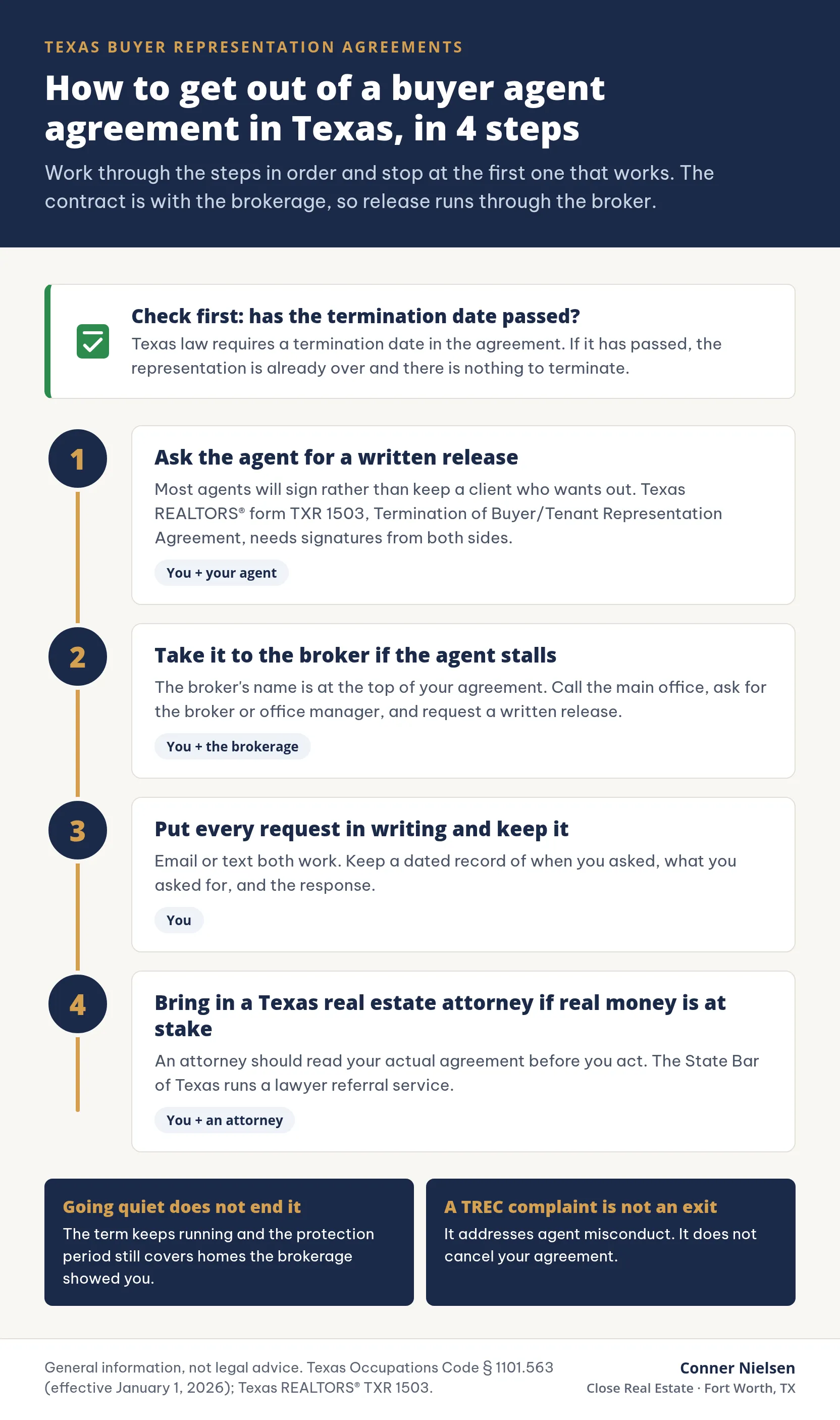
Ask the agent for a written release. Most agents will sign one rather than carry a client who wants out. Texas REALTORS® publishes a form for this, the Termination of Buyer/Tenant Representation Agreement (TXR 1503), and it requires signatures from both sides.
Take it to the broker if the agent stalls. The broker’s name is at the top of your agreement. Call the brokerage’s main office, ask for the broker or the office manager, and say that you want to terminate the representation agreement and are requesting a written release. Brokers handle this regularly and many have a policy for it.
Put every request in writing and keep it. Email or text both work. Keep a dated record of when you asked, what you asked for, and what the response was. If a dispute comes later, that record documents your request.
Get an attorney involved if real money is in play. This article is general information about how these agreements work in Texas. It is not legal advice, and if a specific dollar amount is genuinely at stake in your situation, a Texas real estate attorney should read your actual agreement before you act on anything. The State Bar of Texas runs a lawyer referral service if you do not already have one.
TREC handles license holder complaints against agents who violate the Real Estate License Act or TREC rules. A complaint addresses agent misconduct. It does not cancel your agreement.
When You Can Terminate Without Liability
Most exits without liability fall into three categories.
The agreement expires. The representation ends on the termination date without a signature or a negotiation. The protection period may still apply to properties you were shown, but the representation itself is finished.
Both sides sign a written release. Because the contract is with the brokerage, a release needs the broker’s signature. A mutual release can also settle the open questions in writing, including whether any fee is owed and whether the protection period survives. Ask for a release that settles both points in writing.
A provision in your specific agreement is triggered. Some agreements include termination rights, notice provisions, or conditions that let one party end the arrangement. Whether yours does depends on which form your brokerage used and what was filled in. Read your paragraph headings and look for the words terminate, termination, or default.
Texas does not give every buyer a unilateral right to walk away from a signed representation agreement. Whether you owe anything depends on the term, the protection period, and the compensation clause in your own document, and on the facts of your situation.
What Walking Away Does Not Do
Going quiet does not end the agreement. The term keeps running, the exclusivity clause stays live, and the protection period still attaches to every property that brokerage showed you.
For example, a buyer tours four houses with Agent A in March, decides Agent A is not a fit, stops returning calls, and starts working with Agent B in May. In June the buyer closes on one of the four houses from March. If the original agreement was exclusive, the protection period was still open, and that address was on the brokerage’s list, the first brokerage has a claim. The buyer then faces a fee dispute at closing.
To prevent this, get the release in writing before you start with a new agent. If a protection list exists, tell the new agent which addresses are on it. A competent agent will avoid those houses until the window closes, or will have the compensation question settled in advance.
What to Read Before You Sign the Next One
If you have an unsigned agreement in front of you, four things are worth checking before you sign:
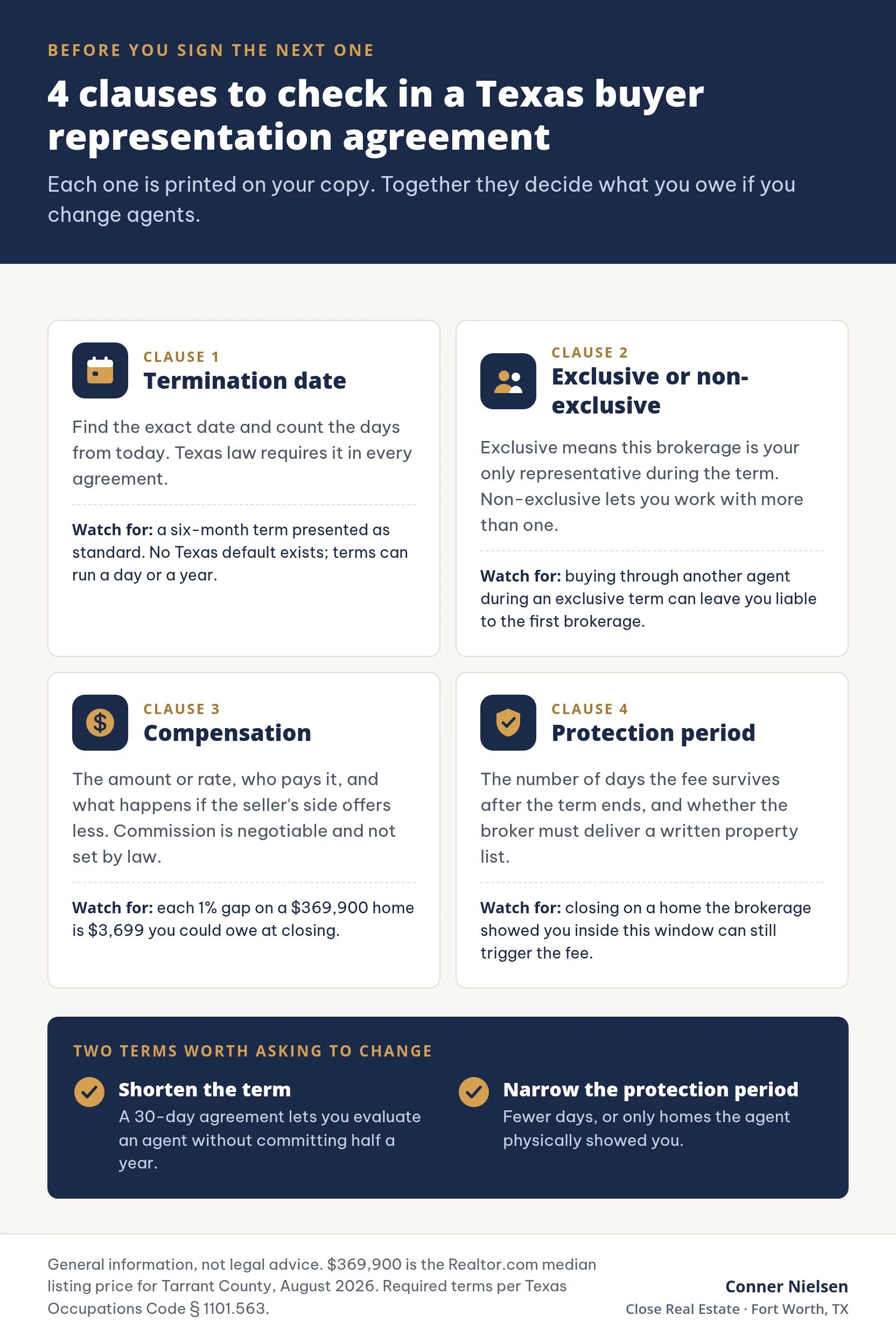
Two terms are worth asking to change. Shorten the term, since a thirty-day agreement lets you evaluate an agent without committing half a year to the decision. Then narrow the protection period, either by shortening the window or by limiting it to properties the agent physically showed you rather than every home ever mentioned.
Asking for both is normal. I keep a list of questions to ask before you hire anyone, along with a longer guide to choosing a realtor in the DFW market.
The Version With No Lock-In
I built my practice so this article never applies to my clients. Card 5 of my 13 guarantees reads:
Cancel Anytime. No 6-month buyer agreements and no exclusive listings with lock-in clauses. Send me a text and the representation ends that day.
My clients have no protection period to dispute later, because I do not ask anyone to sign a six-month exclusive.
Three more of the 13 set the rest of the terms:
Paid Home Inspection. Buyer or seller, I pay for the home inspection out of my own pocket. You see every issue before signing anything.
Buy Without Paying a Dime. Buyers never pay me a commission. Commissions are negotiable and not set by law; where a seller won’t cover the buyer side, I absorb the difference.
Accountability Penalty. If I’m late, dishonest, or drop a ball on any commitment, I Venmo or Zelle you $100 on the spot. Real-money standards, not slogans.
All 13 sit on the page with my written guarantees, and they are in the agreement I sign before you sign anything.
My past clients publish their phone numbers on my client references page, and you are welcome to call them before we ever meet.
Get a Read on Your Agreement Before You Sign Anything
Book a free 10-minute Initial Consultation if you have an agreement in hand and want a plain reading of the term, the exclusivity, and the protection period. Bring the agreement and I will walk you through what each paragraph does. There is no pitch and no obligation. If you have not signed anything yet, my buyer representation page covers what I do on the buy side and why it costs you nothing.
Frequently Asked Questions
Can you fire your realtor in Texas?
You can stop working with an agent at any time, but stopping work and ending the agreement are two separate things. If you signed a buyer representation agreement, it stays in force until it expires, until the broker signs a written release, or until a termination provision in that specific agreement is triggered. Ask the agent for a written release first. If that goes nowhere, take the request to the broker, because the broker is the party to your contract.
Do I have to pay a realtor if I don't buy a house?
In most cases, no. Buyer representation agreements in Texas are generally structured so the broker's fee is earned at closing on a purchase. If you never buy, there is usually nothing to pay. Read your compensation paragraph anyway, because some agreements include a retainer or a fee that survives the term. The amount and how it is calculated have to be written into the agreement.
What is a protection period in a buyer representation agreement?
It is a window of time after the agreement ends during which the brokerage can still claim its fee if you buy a property it introduced you to or showed you during the term. It is also called a continuation period. The length is written into the agreement, and many versions require the broker to deliver a written list of the properties it is claiming. It is the clause most buyers overlook when they switch agents.
How long is a typical buyer agent agreement in Texas?
There is no legal default. Texas law requires the agreement to state a termination date, but the length is negotiated. Full representation agreements commonly run anywhere from a single day to six months or longer. Showing-only non-representation agreements are capped at 14 days under state law. If a term feels long, ask for a shorter one before you sign.
Can I work with two realtors at once?
Only if neither agreement is exclusive, or if the agreements cover different areas or property types. An exclusive agreement means the brokerage is your sole representative for the term, and buying through someone else during that window can leave you owing a fee under the original agreement. Check the exclusivity paragraph before you start working with a second agent.
What happens if I just stop talking to my agent?
The agreement stays in force. The term counts down to its termination date, the exclusivity clause stays active, and the protection period still attaches to any home that agent showed you. Buyers who go quiet and then close with someone else are the ones most likely to hear from the first brokerage. A written release closes the file properly.
Related Articles

Earnest Money Refund in Texas: How to Get Yours Back
I explain exactly when Texas buyers get earnest money back, what forfeits it, and how my written guarantee covers a loss caused by my error, not yours.

What Is Earnest Money? A Texas Buyer's Complete Guide
What is earnest money, how much do Texas buyers put down, and when can you actually lose it? A Fort Worth agent explains the option period and the rules.