Earnest Money Refund in Texas: How to Get Yours Back
Getting an earnest money refund in Texas depends on one thing: which paragraph of the contract you’re standing in when the deal falls apart. You lose the deposit if you miss a deadline, even with a good reason. You get every dollar back if you terminate under a contract right that’s still open, even mid-fight with a seller who wants to keep it. The house, the price, and how reasonable your explanation sounds have nothing to do with it.
I sell real estate in Fort Worth and the surrounding DFW counties, and I’ve watched buyers guess wrong about this more than almost anything else in a transaction. The refund works stage by stage, and each stage has a different fix when the other side won’t cooperate.
Is Earnest Money Refundable in Texas?
Yes, under specific conditions tied to the contract itself, not to fairness or good intentions.
If you want the full definition of earnest money, typical DFW amounts, and how the option period works, I cover that separately in my guide to earnest money basics. This article picks up from there. It covers what buyers actually search for once a deal is wobbling: whether the money comes back, and how to get it released.
The short version: you get a refund when a contract provision still protects you at the moment you terminate. You lose the deposit when you terminate (or simply disappear) with no provision left to stand on.
When You Get a Full Refund
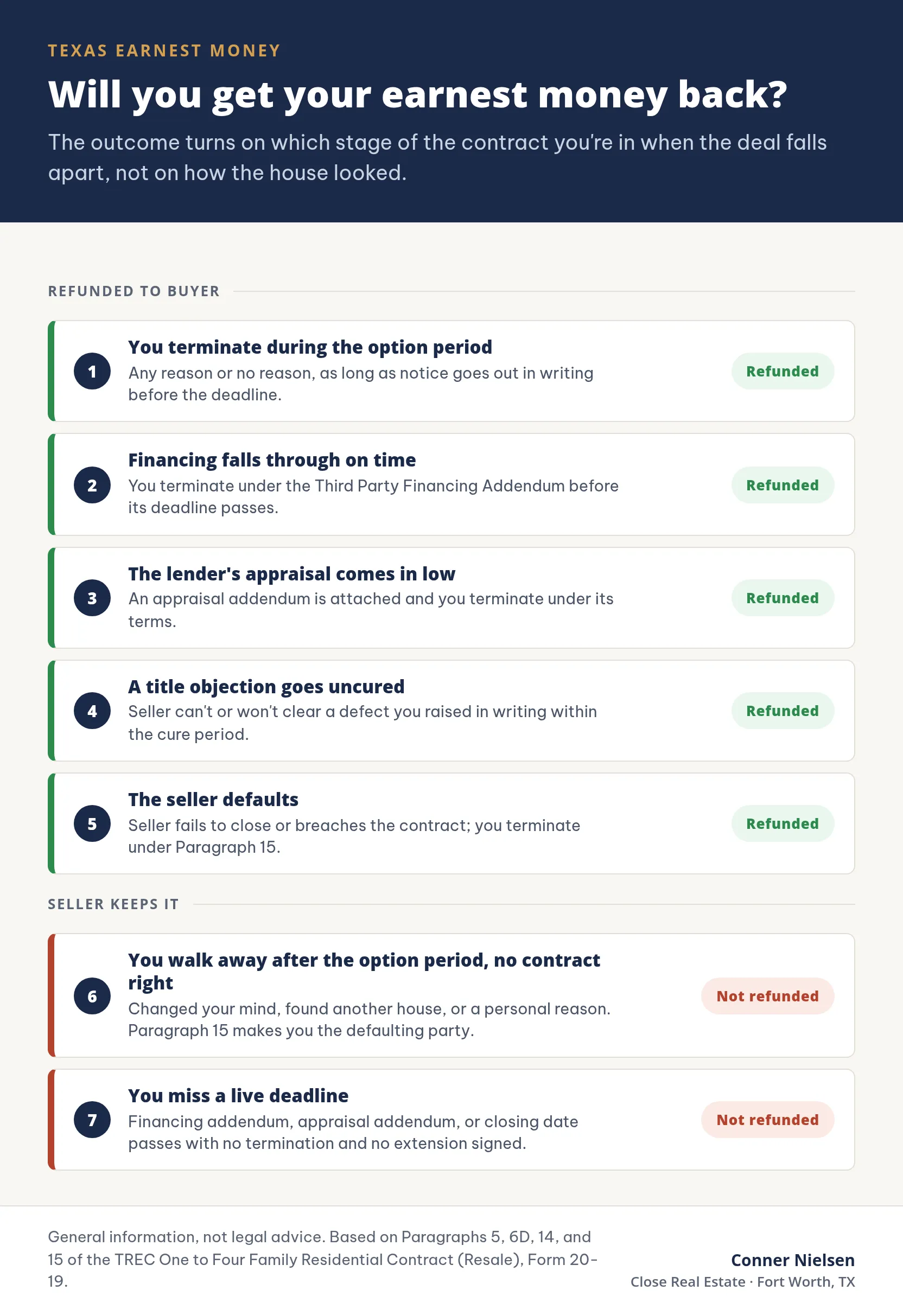
Five situations return the deposit to you in full. Each one depends on a specific contract right, not on how the negotiation feels.
During the Option Period
The option period is the unrestricted window at the start of the contract. Terminate in writing before it expires, for any reason or none, and the earnest money comes back in full. The option fee itself never refunds, but the earnest money is untouched by the option fee’s rules.
When Financing Falls Through on Time
Most contracts attach a financing addendum with its own deadline. Notify the seller that financing fell through, and terminate before that deadline, and the deposit is refunded. A lender’s pre-approval letter isn’t a final underwriting approval, and this contingency protects the gap between the two. If you want a head start on that gap, lock in a mortgage pre-approval before writing an offer, so the financing deadline isn’t the first time a lender reviews your file.
When the Appraisal Comes in Low
If an appraisal addendum is attached to your contract and the lender’s appraisal comes in under the number the addendum names, you can terminate under its terms and get the deposit back. Without that addendum attached, a low appraisal by itself doesn’t create a refund right. It just leaves you to renegotiate, cover the gap in cash, or walk away and forfeit the deposit.
When a Title Objection Goes Uncured
If a title defect or encumbrance shows up in the title commitment and you raise it in writing inside the objection period, the seller gets a cure period to fix it. If the seller can’t or won’t cure a timely objection, you can terminate and the earnest money is refunded. Title insurance is the policy that protects you against a defect nobody caught before closing, and its cost is a fraction of what a real title problem can run.
When the Seller Defaults
If the seller fails to close, fails to deliver clear title, or otherwise breaches the contract, you can terminate under Paragraph 15 and the earnest money comes back. You may also have further remedies against the seller under the contract, separate from the deposit itself.
When the Seller Keeps It
Two situations flip the outcome, and they’re both about timing rather than merit.
You walk away after the option period with no contract right. You changed your mind, found a house you liked better, or had a personal reason unrelated to the contract. None of those is a contract provision, so Paragraph 15 makes you the defaulting party, and the seller is entitled to keep the deposit as liquidated damages.
You miss a live deadline. The financing addendum, the appraisal addendum, or the closing date passes with no termination sent and no written extension signed. A deadline that expires without action closes off the right that deadline protected, whether or not you meant to let it lapse.
How to Get Your Earnest Money Released
Once a contract terminates, getting the deposit moving takes a specific sequence. It runs through the escrow agent named in your contract, which in almost every DFW transaction is the title company holding the funds.
Confirm the Termination Is in Writing
A phone call or a text saying “we’re done” doesn’t start the release process on its own. The termination notice, and the specific contract right it relies on, needs to be in writing and delivered to the other party the way your contract’s notice paragraph requires.
Request the Release From the Escrow Agent
Either party, or the escrow agent itself, can send a release of the earnest money for both sides to sign. Both buyer and seller execute it and return it to the escrow agent, who then disburses the funds accordingly.
Checklist
Before You Sign a Release
Read these before you sign anything the escrow agent sends you.
- Confirm the amount matches your contractCheck it against the earnest money figure on your signed contract, not a rounded estimate.
- Confirm who it's being released toA release can name either party, or split the funds. Read the payee line.
- Keep a copy before you mail it backPhotograph or scan the signed release before it leaves your hands.
- Ask what happens to unpaid expensesThe escrow agent can deduct authorized expenses incurred on your behalf before disbursing the balance.
- Don't sign anything you don't understandA release can also settle other open questions in writing. Read every line, not just the dollar amount.
General information, not legal advice. Your specific contract and escrow agent may add steps.
Send a Written Demand If the Other Side Won’t Sign
If the other party won’t execute the release, either party can make a written demand to the escrow agent for the earnest money. The escrow agent then sends a copy of that demand to the other side. If the escrow agent receives no written objection within 15 days, it can disburse the funds to the party who made the demand. The only deduction is for unpaid expenses incurred on that party’s behalf.
What Happens If the Other Side Won’t Sign?
A demand doesn’t always end the disagreement. If the other party objects within the 15-day window, the escrow agent typically holds the funds until both sides resolve the dispute directly, through mediation, or through a court.
The contract also creates a real consequence for stonewalling. Under Paragraph 18D of the current TREC contract, a party has 7 days from receiving the request to sign a release the escrow agent will accept. Wrongfully failing or refusing to sign within that window makes that party liable to the other side for damages, the earnest money itself, reasonable attorney’s fees, and the costs of suit. Texas contracts also point unresolved disputes toward mediation before either side heads to court. The prevailing party in any resulting legal proceeding can recover reasonable attorney’s fees as well.
This article explains how the process works in general. It isn’t legal advice for your specific dispute. If real money is genuinely contested, a Texas real estate attorney should look at your actual contract and the facts before you sign anything or file anything.
Option Fee vs. Earnest Money: What a Refund Actually Means
The two amounts refund under opposite defaults. The option fee is never refunded, whether you terminate on day one of the option period or close on the house 30 days later. It simply buys the unrestricted right to walk away during that window, and it credits toward your purchase at closing if you proceed. Earnest money is the separate, larger deposit. It’s refundable by default whenever a contract right you haven’t waived is still open, and it’s forfeited only when none is.
My Earnest Money Guarantee
I do something on this specific risk that most agents in DFW don’t.
If you lose your earnest money because of an error or omission on my side, I write you a personal check to cover the full amount.
That’s Card 2 of my 13 written guarantees, in the agreement I sign before you sign anything. It’s scoped on purpose: it covers a deposit lost because I missed a deadline, mishandled paperwork, or otherwise made a mistake that cost you the money. It doesn’t cover a buyer-seller dispute over who is contractually entitled to the deposit. That outcome turns on the facts and the contract terms, not on anything I control.
As part of my buyer representation, every deadline in your contract goes on a calendar the day it goes effective, with reminders well before the date. Every deadline this article covers gets flagged before it becomes a loss. The deposit also gets credited toward your closing costs at the finish line, the same way it would with any agent. The difference is what happens if something on my end goes wrong before you get there.
Know Your Refund Odds Before You Write an Offer
Most earnest money fear comes from not knowing your deadlines, not from the money itself. Once you know which contract right protects you at each stage, and what your actual deadlines are, the fear mostly goes away.
Book a free 10-minute Initial Consultation and I’ll walk through your specific situation, what earnest money you should put down for the price range you’re shopping, and exactly which deadlines matter for the contract you’re about to sign.
Frequently Asked Questions
Is earnest money refundable in Texas?
Sometimes, and it depends entirely on which stage of the contract you're in when things fall apart. Inside the option period, yes, for any reason. After the option period, you get a refund only when a specific contract right is still open: an unmet financing or appraisal contingency, an uncured title objection, or a seller default. Walk away with no contract right left, or miss a deadline, and the seller keeps it as liquidated damages under Paragraph 15.
How long does it take to get an earnest money refund in Texas?
If both sides agree, a signed release can move in a few days, as fast as the escrow agent processes it. If one side won't sign, the written demand procedure in Paragraph 18C gives the other party 15 days to object before the escrow agent can disburse the funds to the party who demanded them. Add time if a dispute drags past that window into mediation or a claim.
What happens if the seller won't sign the earnest money release?
You send a written demand to the escrow agent, who is required to give the seller a copy and wait 15 days for an objection. No objection, and the escrow agent can release the deposit to you. Beyond that, Paragraph 18D makes any party who wrongfully refuses to sign a release liable for the earnest money, damages, reasonable attorney's fees, and the costs of suit. This is general information about how the contract works, not legal advice for your specific dispute.
Do I get my earnest money back if my loan falls through?
Yes, if you terminate within the deadline set by the Third Party Financing Addendum attached to your contract. That addendum gives you a window to notify the seller that financing fell through and cancel with a full refund. Miss the deadline without terminating, and you've accepted the financing risk yourself, so a later loan denial no longer protects the deposit.
Is the option fee refundable if I don't buy the house?
No. The option fee is never refunded, whether you terminate during the option period or close on the house. It's a separate, smaller payment, commonly $100 to $500 in DFW, that buys you the unrestricted right to walk away. It does credit toward your purchase at closing if the deal goes through. Earnest money is the separate, larger deposit that does come back to you under the conditions above.
Can the buyer and seller both claim the same earnest money?
Yes, and it's the scenario that produces most earnest money disputes. Both sides believe they're entitled to the deposit, neither signs the other's release, and the money sits with the escrow agent until someone sends a written demand or both sides agree. Texas contracts also point disputes toward mediation before litigation. Whoever is right on the facts still has to go through that process to get paid.
What does Conner's earnest money guarantee cover?
Conner covers a deposit lost because of an error or omission on his side, such as a missed deadline or a paperwork mistake he made. If that happens, he writes a personal check for the full amount. It's Card 2 of his 13 written guarantees. It doesn't cover a buyer-seller dispute over contract rights. That outcome depends on the contract terms and the facts of the transaction, not on anything Conner controls.
Related Articles

How to Get Out of a Buyer Agent Agreement in Texas
A signed buyer agent agreement in Texas turns on three clauses: term length, the protection period, and exclusivity. How release through the broker works.
What Is Earnest Money? A Texas Buyer's Complete Guide
What is earnest money, how much do Texas buyers put down, and when can you actually lose it? A Fort Worth agent explains the option period and the rules.