How to Interview a Real Estate Agent Before You Sign

Interviewing a real estate agent is a hiring decision, and most people run it like a first date instead. They meet one agent, like how the conversation went, and sign. No comparison, no notes, no second opinion.
That approach skips the part that actually predicts the outcome. An interview only works as a filter when you run the same process on more than one candidate and score what you hear instead of how you felt about it. This guide covers how to interview a real estate agent step by step: how many to talk to, how to set the meeting up, what to bring, how to read an evasive answer, how to score what you hear, how to compare two finalists, and what happens after you pick one.
If you want the specific questions to ask during the conversation, I’ve written a complete list with strong and weak sample answers for each one. This guide assumes you have that list, or one like it, and focuses on running the interview around it: the format, the scoring, and the paperwork that follows.
Why the Interview Decides More Than the Questions Do
The questions matter less than whether you ask them more than once.
NAR’s 2023 Profile of Home Buyers and Sellers found that 71% of buyers interviewed only one real estate agent during their home search. A single interview tells you whether you liked one person. It tells you nothing about whether that person was a better choice than the other agents working your zip code, because there’s nothing to measure it against.
The fix costs almost nothing. Interviewing a second or third agent adds maybe 20 minutes of phone calls, and it turns a personality read into an actual comparison. The rest of this guide assumes you’re doing that.
How Many Agents to Interview
Two or three is enough, as long as every one of them gets the same questions in the same order and a score written down immediately afterward.
Buyers and sellers ask slightly different things in that conversation. A seller’s version should add pricing strategy, the marketing plan, and who covers pre-listing costs like cleaning and repairs, since that bill lands before any sale proceeds exist. Ask a candidate to walk through their full scope as a listing agent before you score the answer, since a vague scope usually means a vague marketing plan too.
More than three interviews rarely adds information. Past that point you’re comparing personalities, not records, and the extra calls cost time without changing the decision.
How to Set Up the Interview
A 10-minute phone or video call is enough to cover license status, track record, and cancellation terms. Set aside 30 to 45 minutes if you want to go deeper on strategy, pricing philosophy, or neighborhood specifics, and do it in person or on video rather than by text.
Send an agenda before the call. A short message naming the topics, license and broker, last year’s closings, communication cadence, cancellation terms, keeps the conversation on track and gives the agent no excuse to ramble past the parts that matter.
Ask for two documents ahead of time: a written net sheet or cost estimate, and a sample of the representation agreement you’d be asked to sign. An agent who sends both before the call is showing you how they’ll handle paperwork after you hire them. Tarrant County listings carry a 51-day median time on market (August 2026, Realtor.com), so also request a weekday-afternoon showing on 48 hours’ notice and watch whether it actually happens. An agent who can’t manage that scheduling test during the interview will cost you houses once you’re under a deadline.
Before the call
What to bring to the interview
Buyers and sellers need slightly different documents. Bring a printed copy of this list.
- Your price range and target areasBuyers only. Narrow enough that the agent can speak to actual inventory, not a metro-wide guess.
- A mortgage pre-approval letter, if you have oneBuyers only. Tells the agent what price band is realistic before the tour even starts.
- A target sale date and known repairsSellers only. The agent's prep timeline and cost estimate both depend on this.
- A rough sense of nearby comparable salesSellers only. Lets you sanity-check the agent's pricing strategy against something.
- A printed scorecard for the five scoring dimensionsEveryone. Score immediately after the call, not from memory the next day.
- A pen and a way to record the license numberEveryone. You'll check it against the TREC license database within the hour.
Send the price range, timeline, or repair list ahead of time if you can. It lets the agent prepare a real answer instead of an improvised one.
Reading the Room: What Evasion Actually Looks Like
Some answers are wrong in ways that are easy to miss live, because they sound confident.
Pivoting to the brand instead of the person. “We’re the number one team in the area” answers a question about the company, not about who handles your file. Ask directly who signs the offer and who negotiates the inspection response.
Volunteering availability instead of a number. “I’m always reachable” is a promise with no way to check it. A specific cadence, twice a week by text during an active transaction, for example, is a claim you can hold someone to.
Treating the cancellation question as an inconvenience. Watch the reaction when you ask how you’d end the relationship, not just the answer. Hesitation or a pivot to why a long term protects you both are both signals worth writing down.
Rounding the transaction count. A number that’s suspiciously easy to say and doesn’t include a neighborhood or a timeframe is either a memorized pitch line or a team total being presented as personal production. Ask for one specific closing from the last three months and see how much detail follows.
None of these disqualify an agent by themselves. What matters is whether the pattern repeats across more than one question, which is exactly what interviewing a single candidate can’t show you.
How to Score What You Hear
Score every agent on the same five dimensions, right after the call, before the impression fades.
- Verifiable record. Closed transactions you can check on the license database and a consumer MLS portal, not a number you have to take on faith.
- Accountability in writing. A written consequence for a missed deadline or a broken commitment, with a dollar figure in the agreement rather than a verbal promise.
- Communication plan. A specific cadence and channel, tested during the interview itself rather than just promised during the pitch.
- Exit terms. A cancellation clause you read before signing, with a term and protection period you understood going in.
- Fit. Whether you’d actually return this person’s call at 9pm on a Friday. It’s the one dimension you can’t verify, and it still counts.
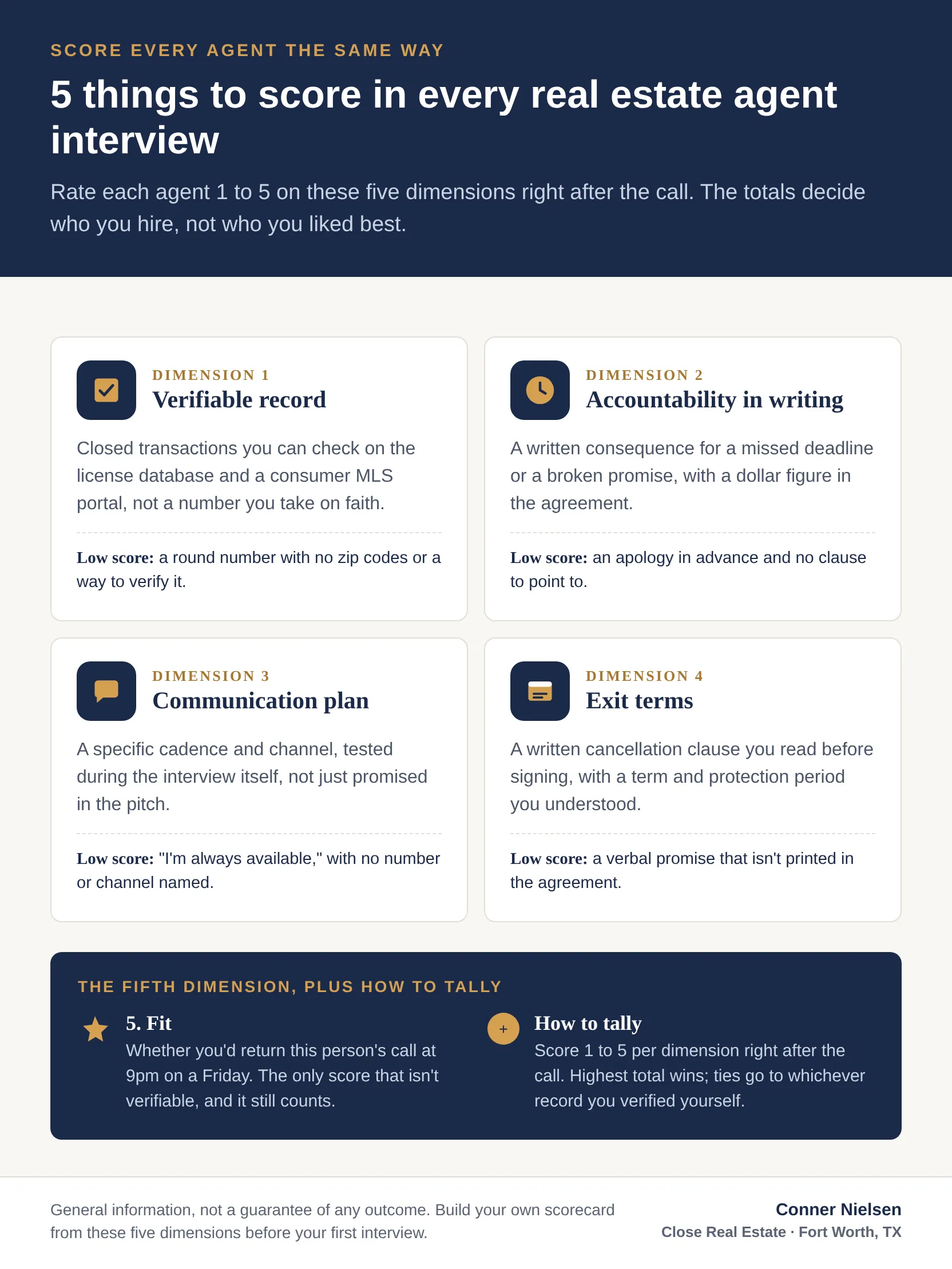
Rate each dimension 1 to 5 and add the total. The highest score wins the hire, not whichever agent you spoke to first or liked best in the room. Ties go to whichever record you were able to verify independently, since that’s the dimension with the least room for a good pitch to fake it.
Comparing Two Finalists Side by Side
Once two agents clear the interview, put their scores next to each other before you decide.
| Dimension | Agent A | Agent B |
|---|---|---|
| Verifiable record | 11 closings last year, named zip codes, checked on HAR.com (5) | A round number, no zip codes given (2) |
| Accountability in writing | A dollar figure in the agreement for a missed deadline (5) | A verbal promise to communicate well (1) |
| Communication plan | Twice-weekly by text, confirmed during the interview (5) | “I'm very responsive,” no cadence named (2) |
| Exit terms | Cancel by text, no lock-in term (5) | Six-month term, cancellation at broker discretion (1) |
| Fit | Returned the pre-interview documents same day (4) | Sent documents three days late, after a reminder (2) |
| Total | 24 | 8 |
A side-by-side table does something a memory of two separate conversations can’t: it puts the weak answer next to the strong one on the same line, which is usually where the decision becomes obvious.
Verifying Claims Before You Sign Anything
Every claim above has a way to check it without taking anyone’s word for it, including mine.
License and broker. TREC’s license search shows status, sponsoring broker, and any disciplinary history for every agent in Texas. This takes about a minute and catches the rare case where a license has lapsed or carries discipline the agent didn’t mention.
Transaction count. Texas is a non-disclosure state, so sale prices aren’t public record and no county office totals sales by agent. The working substitute is the agent’s MLS profile on a consumer portal such as HAR.com, plus asking them to describe three recent closings from memory. My three records guide covers this verification method in more depth if you want the full mechanics.
Past clients. Call the phone numbers, not a curated review page, and ask two questions: did the agent do what they said, and what went wrong during the transaction. The second question matters more, since almost every deal hits a snag and the answer shows how the agent actually handles one.
What Happens After You Pick Someone
The interview produces a decision. The agreement you sign afterward produces obligations, and reading it carefully matters as much as the interview did.
Texas law changed the paperwork itself. Under new sections of the Real Estate License Act that took effect January 1, 2026, a license holder must have a written agreement with a prospective buyer, either a full representation agreement or a narrower non-representation showing-only agreement, before showing a residential property or presenting an offer on the buyer’s behalf. Texas Occupations Code Section 1101.563 is the statute behind the rule. Every version of that agreement has to state the termination date, whether it’s exclusive, and the compensation the broker will receive, disclosed in plain language as negotiable and not set by law.
Read four things in that document before signing: the term, the protection period (how long a commission can still be owed after the term ends on someone the agent introduced), the cancellation clause, and the compensation clause. On the buyer representation side, that compensation clause determines who pays the agent if the seller’s side doesn’t cover it. On the seller representation side, the commission math explains where each side of a typical split goes and why the rate is never fixed by law.
How I Score When You Run This On Me
The same five dimensions apply to me, and each answer below comes with the way to check it.
Verifiable record. 300+ closed transactions with 102 independently verified on my HAR.com record, across Dallas, Tarrant, Ellis, Parker, Johnson, Collin, Wise, and Denton Counties, under license NTREIS-0704632.
Accountability in writing. If I’m late, dishonest, or drop a ball on any commitment, I Venmo or Zelle you $100 on the spot. It’s a numbered item in the same agreement I sign before you sign anything, listed with the rest of my written guarantees.
Communication plan. Minimum twice-weekly contact during an active transaction, confirmed by the same clients whose phone numbers I publish on my client references page.
Exit terms. No six-month buyer agreements and no exclusive listings with lock-in clauses. Send me a text and the representation ends that day.
Fit. That one’s yours to score. Book the call and find out, or call my past clients first and ask what it was actually like to work with me. More on how I got here is on the About Conner page.
Check Every Claim Yourself
None of the above requires trusting me. These are the same public databases and records behind every score above.
Resources
Verification tools and primary sources
Run through these before your first interview, mine or anyone else's.
- TREC license searchTexas Real Estate Commission
Status, sponsoring broker, expiration, and disciplinary history for every license holder in Texas.
- What changed in 2026 about buyer representationTexas Real Estate Commission
The written-agreement requirement that took effect January 1, 2026, explained in plain terms.
- Texas Occupations Code Section 1101.563Texas Legislature
The statute text behind the written buyer-agreement requirement.
- 2023 Profile of Home Buyers and Sellers (highlights)National Association of Realtors
Source of the 71% one-agent-interviewed figure cited above, from the association's annual buyer and seller survey.
- My HAR.com recordHouston Association of Realtors
102 independently verified closed transactions, published under license NTREIS-0704632.
- My written guaranteesConner Nielsen
All 13 commitments with the dollar amount attached to each one, signed before you sign anything.
Bring the Scorecard to a Ten-Minute Call
Interview two or three agents, score all of them on the same five dimensions, and hire whichever total you were able to verify yourself. That process beats going with the first person you happened to meet.
Book a free 10-minute Initial Consultation and run the whole interview on me. It’s a Zoom call where I tell you plainly whether to move now or wait, and I send $100 by Venmo if you feel it wasted your time. You can also call me at 806-928-8884 and ask everything over the phone instead.
Frequently Asked Questions
How many real estate agents should I interview before choosing one?
Two or three, using the same format and the same scorecard for each one. NAR's 2023 Profile of Home Buyers and Sellers found 71% of buyers interviewed only one agent, which means most people skip the comparison that actually decides the hire. Conner recommends writing down the score for each of the five dimensions right after each call, while the answers are still fresh.
What should I bring to a real estate agent interview?
Buyers should bring a price range, target areas, a timeline, and a mortgage pre-approval letter if one exists. Sellers should bring a target sale date, a list of known repairs, and a rough sense of nearby comparable sales. Everyone should bring a printed scorecard, so every agent gets rated on the same five dimensions instead of relying on memory afterward.
How long should a real estate agent interview take?
Conner runs his as a 10-minute Zoom call, the free Initial Consultation, and tells you plainly whether to move now or wait. Longer in-person interviews with other agents commonly run 30 to 45 minutes. Either length covers license status, transaction record, communication cadence, and exit terms without padding.
What's a red flag during a real estate agent interview?
The agent can't produce a license number without pausing, pivots to describing a team instead of naming who handles your file, or has no answer when asked how you'd cancel the agreement. A prepared agent answers all three in under a minute, because the answers are already written down somewhere.
Do I have to sign an agreement before an agent shows me a house in Texas?
Yes. Texas Occupations Code Section 1101.563 has required a written agreement, either a representation agreement or a narrower non-representation showing-only agreement, before a license holder shows a residential property since January 1, 2026. Read the term, the cancellation clause, and the compensation section before signing either version. Conner's version carries no lock-in term: a text ends the representation the same day.
What happens during Conner's free Initial Consultation?
It's a 10-minute Zoom call structured like the interview this guide describes. Conner answers the five scoring dimensions in order, tells you plainly whether to move now or wait, and sends $100 by Venmo if you feel it wasted your time. Completing it also enters you in a $2,000 monthly drawing. Booking runs through the schedule page, or you can call 806-928-8884.
Related Articles

10 Questions to Ask a Realtor Before You Hire One
Ten questions to ask a realtor before you hire one, what a strong answer sounds like, what a weak one sounds like, and how to check each claim yourself.