The Fort Worth HAP Program: How to Get Up to $25,000 for Your Down Payment

Fort Worth’s Homebuyer Assistance Program puts up to $25,000 toward a first-time buyer’s down payment and closing costs, and the money never accrues interest. Most of what gets written about it stops at that number. The parts that decide whether the program actually works for you are the forgiveness structure, the specific costs it does not touch, and the sequence you have to follow with a city-approved lender to get the file approved.
I work HAP files with buyers on the first-time-buyer side of nearly every deal I close inside Fort Worth city limits, so this covers the program the way the first-time buyer guide frames the rest of the purchase: what the city actually requires, what still comes out of your pocket, and how the pieces fit together with your first mortgage.
Snapshot
Fort Worth HAP at a Glance
The core terms before the full breakdown below.
- Maximum assistance
- Up to $25,000, interest-free
- Structure
- Forgivable second lien behind your first mortgage
- Forgiveness
- Full term at year 5 ($14,999 or less) or year 10 (up to $25,000)
- Income limit
- 80% of the area median the city publishes, by household size
- Property location
- Inside Fort Worth city limits only
- Minimum contribution
- $1,000 or 2% of the purchase price, whichever is less
- Reserves required
- 2 months of mortgage payments, no gift funds
- Education requirement
- 8-hour homebuyer class, free, through an approved local agency
City of Fort Worth Homebuyer Assistance Program guidelines, current as of September 2026.
Who Qualifies for Fort Worth HAP
Five conditions decide eligibility, and all five have to clear before your lender submits a file to the city.
You need to be a first-time buyer, or you need to not have owned a home in the last three years. Displaced homeowners, meaning someone who previously owned a home with a former spouse and no longer lives there, may also qualify with a divorce decree on file.
The property has to sit inside Fort Worth city limits. City limits follow a specific legal boundary rather than a zip code, so confirm the exact line against the Tarrant Appraisal District’s own records before you assume a Fort Worth mailing address qualifies. Fort Worth’s median sale price ran $327,500 as of August 2026 (TRERC / NTREIS MLS). Compare that against this year’s sales price cap, which your HAP-approved lender can confirm.
The city’s HAP page spells out that the sales price itself is capped at 95% of the area median sales price, under the federal HOME program rule 24 CFR 92.254(a)(2)(iii). The city’s own lender guidance has listed specific dollar caps in past cycles, so ask your HAP-approved lender for this year’s exact number before you write an offer rather than assuming last year’s figure still applies.
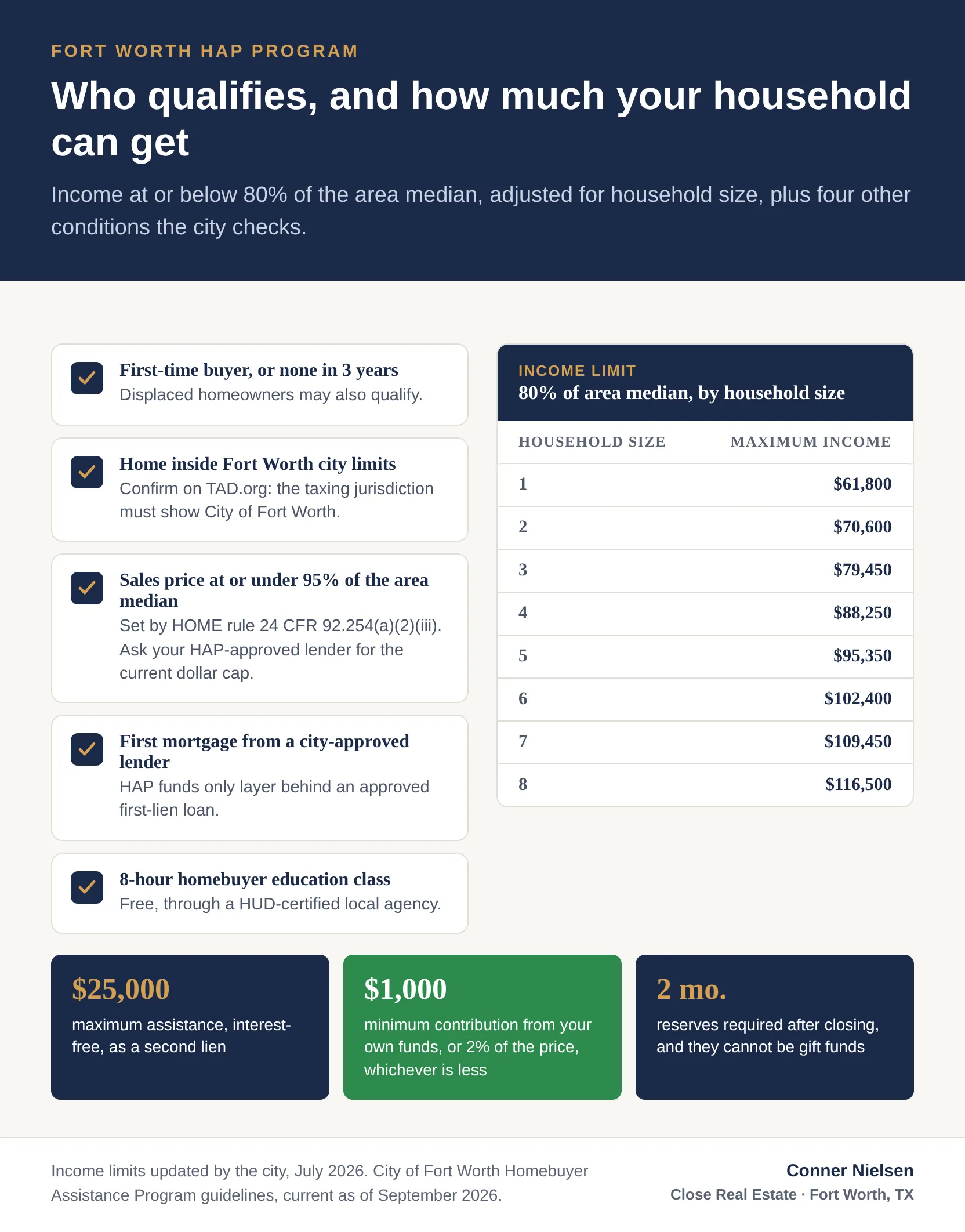
Your household income has to sit at or below 80% of the area median the city publishes, adjusted for household size. The table below reflects the city’s most recent update.
Last, you need to qualify for a first-lien mortgage through a lender the city has approved for the program. HAP only exists as a second lien behind that first mortgage, which is why the lender relationship comes before almost everything else on this page.
How Much You Get and How Forgiveness Works
The $25,000 maximum splits two ways. You can direct up to 3% of your total loan amount toward closing costs and send the rest to your down payment, or you can put the entire amount toward your down payment. Your lender calculates the actual number against the sales price and your approved loan amount, so a smaller purchase or a larger first mortgage can mean less than $25,000 is available.
Forgiveness ties to how much you take, not to the house you buy. Take $14,999 or less, and the city forgives the full balance once you have lived in the home five years as your primary residence. Take more than that, up to the $25,000 ceiling, and forgiveness stretches to ten years, with 20% of the balance written off each year starting in year six.
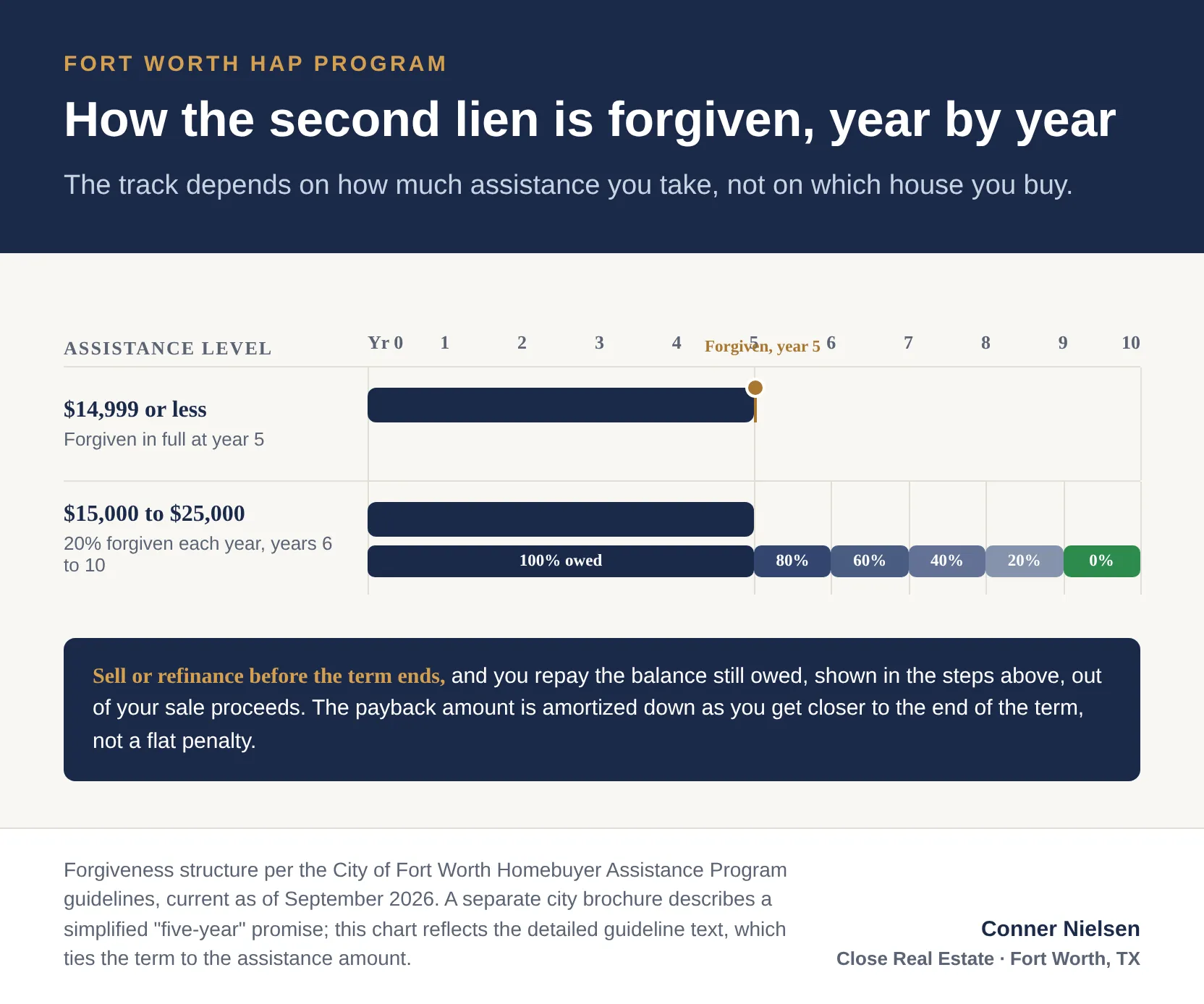
Selling, refinancing, or moving out before your term ends triggers repayment of whatever balance is still outstanding, paid from your sale proceeds. On the ten-year track, the balance drops 20% a year starting in year 6, so leaving in year 8 costs less than leaving in year 6. On the five-year track, nothing is forgiven until year 5, when the full balance is forgiven at once. Reaching zero owed takes the full term, whichever track you are on.
What HAP Does Not Cover: The Cash You Still Need
HAP funds your down payment and part of your closing costs. The city’s own program page states you are still responsible for your earnest money, your option fee, your home inspection, and your appraisal.
Layer on top of that a minimum contribution of $1,000 or 2% of the purchase price, whichever is less, from your own funds, and two months of mortgage-payment reserves that cannot come from a gift. Those reserve funds have to be yours, verified, and sitting in an account before your file gets approved.
| Feature | HAP covers | You pay yourself |
|---|---|---|
| Down payment | Up to $25,000 | Any gap above the assistance amount |
| Closing costs | Up to 3% of your total loan amount | Any remaining closing cost balance |
| Earnest money | Not covered | Typically 1% of the purchase price |
| Option fee | Not covered | $100 to $500 |
| Home inspection | Not covered | Roughly $600 once standard add-ons are included |
| Appraisal | Not covered | Roughly $600 |
| Reserves | Not covered, and cannot be gift funds | 2 months of mortgage payments |
One item on that list never comes out of your pocket with me. Card 1 of my 13 written guarantees reads: “Buyer or seller, I pay for the home inspection out of my own pocket. You see every issue before signing anything.” That money is mine rather than program money, so it stacks with HAP without conflict.
My home inspection cost post breaks that line item down further, and the wider home buying costs hub covers every other fee a Fort Worth purchase carries.
How to Apply for Fort Worth HAP, Step by Step
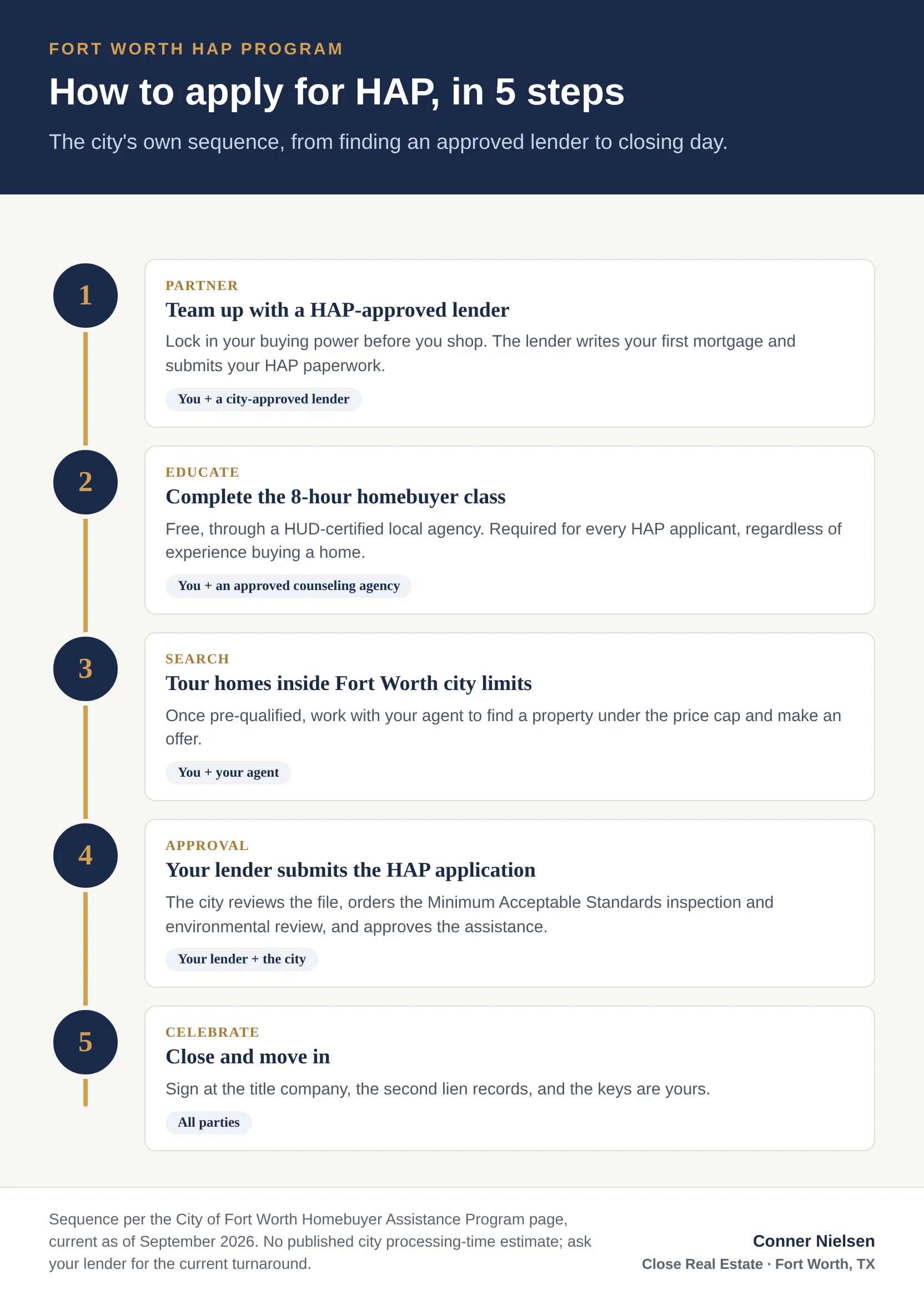
The city lays out five steps, and your lender drives most of them alongside you.
Step 1. Partner With a HAP-Approved Lender
Before you shop
What happens: you find a lender the city has approved for HAP and get pre-qualified. Who does it: you and the lender. Not every mortgage lender participates, so confirm HAP approval before you assume a preferred lender can process your file.
This is also the moment to sort out your mortgage pre-approval, since your pre-qualification number sets your price ceiling for the search step that follows.
Step 2. Complete the 8-Hour Education Class
Before or during your search
What happens: an eight-hour homebuyer education class through one of the city’s approved local counseling agencies. Who does it: you, on your own schedule. What it costs: nothing.
Four agencies currently run this class in Fort Worth: Housing Opportunities of Fort Worth, Housing Channel, Trinity Habitat for Humanity, and the Hispanic Real Estate Brokers Association’s counseling arm in Arlington. Every HAP applicant takes this class, regardless of whether you have bought a home before.
Step 3. Search for a Qualifying Home
Once pre-qualified
What happens: you tour homes inside Fort Worth city limits, under the price cap, and make an offer. Who does it: you and your agent.
This is where an agent who already works HAP files earns their keep. Confirming city limits and a price under the cap before you write an offer saves a file from getting rejected weeks later.
Step 4. Your Lender Submits the Application
After your offer is accepted
What happens: your lender completes and submits the HAP application to the city for review and approval. Who does it: your lender and the city. What it costs: the standard inspection and appraisal fees you already budgeted for.
The city orders a Minimum Acceptable Standards inspection and an environmental review during this step, both at no added cost to you, separate from the option-period inspection you order as the buyer, which I pay for under Card 1 of my written guarantees. Forms for that separate, buyer-ordered inspection come from TREC, the state’s own regulator, not the city.
Step 5. Close and Move In
Closing day
What happens: you sign at the title company, the second lien records behind your first mortgage, and the city’s funds disburse. Who does it: all parties.
Checklist
Before You Apply for Fort Worth HAP
Gather these before your first conversation with a HAP-approved lender.
- Two months of pay stubs and two years of tax returnsEvery household earner's income counts toward the limit, not just the borrower's.
- Proof of your reserve fundsTwo months of mortgage payments, sitting in your own account, not a gift.
- Your minimum contribution of $1,000 or 2% of the purchase price, whichever is lessKept separate from your reserves and your earnest money.
- A signed-up slot for the 8-hour education classBook it early. It can run alongside your home search instead of before it.
- A target list of Fort Worth zip codesConfirm each address against the Tarrant Appraisal District before you fall for a house outside city limits.
- A written confirmation your lender is HAP-approvedAsk directly. Not every lender on a preferred list participates in the program.
Your HAP-approved lender confirms the current income limit and price cap against your specific numbers before you write an offer.
How HAP Works With Your First Mortgage
HAP sits in second lien position, which means your first mortgage gets paid first in a foreclosure or short sale and the city’s claim comes after it. That position is why the program only works through a lender the city has approved: the paperwork, the title language naming the city as second mortgagee, and the loan-to-value math all have to line up between the two liens.
The city accepts a 30-year FHA, conventional, or VA first mortgage. Combined loan-to-value across both liens cannot exceed 105%, and your debt-to-income ratio generally needs to land under 43% combined, with some room up to 50% available through a waiver. None of that changes your credit score requirement, which comes from your first-lien lender rather than from the city.
Fort Worth HAP vs. Statewide Assistance Programs
HAP is a city program, and it is not the only assistance available to a Fort Worth buyer. Two state agencies, including TSAHC, offer up to 5% of your loan amount statewide, structured as a grant or a second lien.
| Feature | Fort Worth HAP | Statewide programs (TSAHC and similar) |
|---|---|---|
| Maximum assistance | Up to $25,000 | Up to 5% of your loan amount |
| Effect on your first mortgage rate | None, it is a separate city lien | Often raises your rate, since the assistance is priced into it |
| Property location | Fort Worth city limits only | Anywhere in the state, income limits vary by county |
| Forgiveness | 5 or 10 years, tied to the amount taken | Commonly 3 years as a forgivable second lien, or an outright grant |
The biggest practical difference is the rate effect. Statewide assistance commonly raises your first mortgage rate because the assistance is priced into it. HAP does not, because it is a separate city lien layered behind a market-rate first mortgage. My full down payment assistance comparison runs the actual break-even math on that rate trade-off across every state and local program a Fort Worth buyer can reach.
Start Your Fort Worth HAP File the Right Way
Getting a HAP file approved comes down to sequencing: the right lender first, the education class booked early, and a clear number for what still needs cash before you write an offer. I walk through your specific income, target zip codes, and the current price cap on the first call, and I already cover the home inspection, one of the costs HAP does not touch. My buyer representation costs you nothing regardless of whether HAP ends up part of your file.
Book a free 10-minute Initial Consultation and I will work out whether you qualify before you spend a weekend touring homes that do not.
Frequently Asked Questions
How much does the Fort Worth HAP program give first-time buyers?
Up to $25,000, interest-free, toward your down payment and closing costs. You can put up to 3% of your total loan amount toward closing costs and the rest toward your down payment, or send the entire amount to your down payment. The actual number you qualify for depends on the sales price and the loan amount your lender approves, so $25,000 is a ceiling, not a guarantee.
What are the income limits for the Fort Worth HAP program?
Your household income has to be at or below 80% of the area median the city publishes, adjusted for how many people live in the home. As of the city's July 2026 update, that is $61,800 for one person, $70,600 for two, $79,450 for three, $88,250 for four, $95,350 for five, $102,400 for six, $109,450 for seven, and $116,500 for eight. The city updates this table every summer, so confirm the current figure before you apply.
Do I have to pay back the Fort Worth HAP program?
Only if you sell, refinance, or stop living in the home before your forgiveness term ends. Take $14,999 or less and the balance is forgiven in full at year 5. Take more than that, up to the $25,000 maximum, and the balance is forgiven 20% a year from year 6 through year 10. Exit early and you repay whatever is still outstanding out of your sale proceeds. On the ten-year track, that amount drops 20% a year from year 6 on.
What credit score do I need for the Fort Worth HAP program?
The city does not publish a minimum score of its own for HAP. Your score has to clear whatever your first-lien mortgage requires, since HAP only layers behind an approved first mortgage. In practice that floor runs around 580 for FHA and 620 for conventional loans, so getting your credit score checked is the first thing to do before you apply.
Can I use Fort Worth HAP with an FHA loan?
Yes. The program accepts a 30-year FHA, conventional, or VA first mortgage, written through a HAP-approved lender. HAP sits behind that loan as a second lien, and it does not change your first mortgage's rate or terms the way some state down payment programs do.
What does the Fort Worth HAP program not cover?
It does not cover the cash you need to reach the closing table. The city is explicit that you pay your own earnest money, option fee, home inspection, and appraisal, plus two months of reserves that cannot be gift funds. I already pay for the home inspection for my buyers, so the gap HAP leaves open is usually smaller than it first looks.
Related Articles

What Credit Score Do You Need to Buy a House in Fort Worth?
580 for FHA, 620 for conventional. But 620 is the number that actually decides your Fort Worth purchase, and it has nothing to do with loan approval.
How Much Does a Home Inspection Cost in Fort Worth?
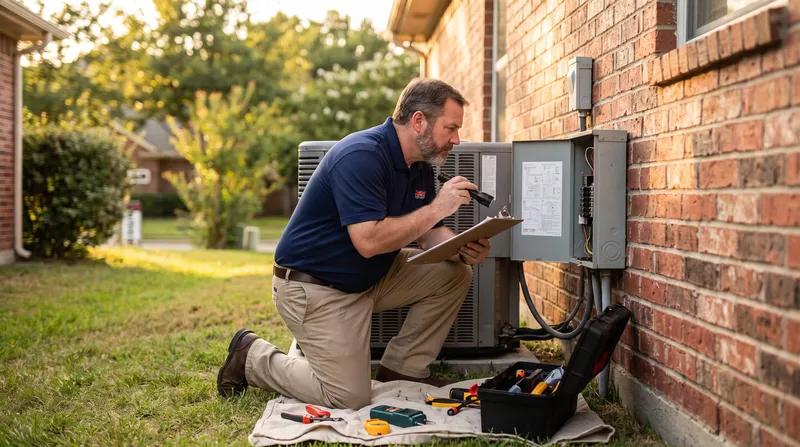
Fort Worth home inspections run $280 to $640 by square footage. What drives the price, which add-ons actually matter here, and why my buyers never pay.

How to Get Pre-Approved for a Mortgage in Fort Worth
What pre-approval takes in Fort Worth: the documents, the credit and DTI thresholds, the 1-3 day timeline, and what your letter is actually worth in 2026.