What Credit Score Do You Need to Buy a House in Fort Worth?
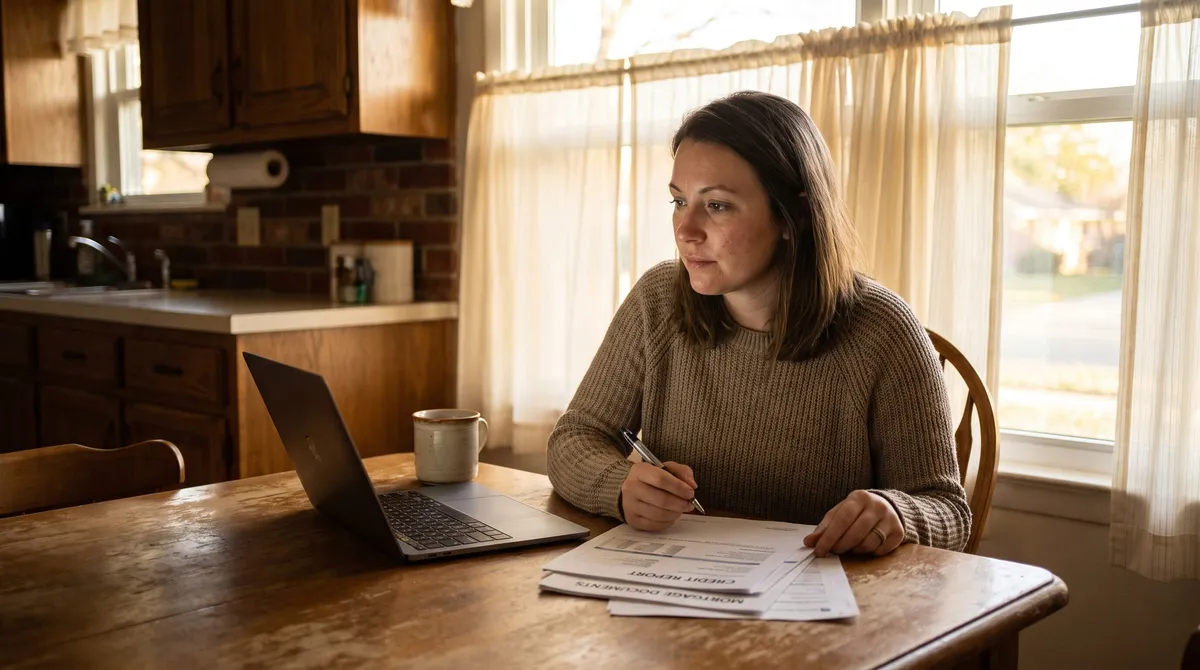
The minimums are 580 for an FHA loan with 3.5% down, 500 to 579 if you can put 10% down, and 620 for a conventional loan. VA and USDA set no agency minimum, so whatever your lender requires is the requirement, and most land between 620 and 640. That is the answer to the question as asked, and it is the same answer in Fort Worth as it is in Amarillo, because these are federal program floors and lender overlays, not local rules.
The more useful question is which number changes your outcome. For a first-time buyer in Tarrant County that number is 620, and loan approval is not why.
How the numbers in this guide work. Every dollar example is anchored to Fort Worth’s $319,999 median sale price for May 2026, the figure in my market report. Band-by-band pricing comes straight from myFICO’s Loan Savings Calculator, which publishes Curinos rate data for a 30-year fixed loan and was last updated August 26, 2026. Read one caveat with it: those quotes assume a 20% down payment, so a first-time buyer putting 5% down prices above every rate in the table. The spread between bands is what carries over to your file, and the spread is what this question is really about. Down payment percentages below are shares of the purchase price, and mortgage insurance percentages are shares of the loan amount. For scale, the Freddie Mac survey average was 6.65% for the week ending August 20, 2026, under most of the table, because that survey pool skews toward strong-credit borrowers putting 20% down.
The Minimums, by Loan Program
| Loan program | Minimum score | Minimum down payment |
|---|---|---|
| FHA | 580 | 3.5% |
| FHA | 500 to 579 | 10% |
| Conventional | 620 typical | 3% and up |
| VA | Lender-set, often 620 | 0% |
| USDA | Lender-set, often 640 (620 through TSAHC) | 0% |
Two things in that table catch people out. The first is the 500-to-579 row: it exists, it is real, and it is close to unusable, because tripling your down payment to save your score is a trade almost nobody wins. On the Fort Worth median it is the difference between $11,200 and $32,000 in cash.
The second is that VA and USDA have no minimum. Buyers read “no minimum” as “no requirement” and are surprised when a lender declines at 590. The agency guarantees the loan; the lender still has to be willing to write it, and it sets its own floor. Ask each lender for its number directly rather than assuming the program’s silence works in your favor. The 640 in the USDA row is a lender overlay rather than a program rule, which is exactly why it moves: TSAHC sets the floor for its own USDA product at 620, and a lender writing that product underwrites to 620. The wider comparison between loan programs turns almost entirely on this number too.
The 620 Cliff, and Why It Is Not About Approval
Here is what the national articles on this keyword miss. In Fort Worth, 620 is not primarily a lending threshold. It is the gate on every down-payment-assistance program a Tarrant County buyer can reach.
The City of Fort Worth Homebuyer Assistance Program offers up to $25,000 toward down payment and closing costs inside city limits, forgiven entirely if you stay 10 years. The city’s published guidelines do not state a credit minimum, and that detail confuses people. The reason is structural: HAP requires you to qualify for a first-lien mortgage from a city-approved lender, and the score requirement lives there, not at the city. In practice that means 620.
The statewide programs are explicit about it. TSAHC requires 620 for its FHA, VA, and USDA products and 640 for its conventional ones. TDHCA’s My First Texas Home runs on the same 620 floor.
So the real cost of sitting at 610 is not a declined application. FHA will lend to you at 610. The cost is that $25,000 in city assistance, plus up to 5% of the loan amount from the state, becomes unreachable over 10 points. That is the most expensive 10 points in this market, and it is the reason I push buyers who are close to spend 60 days on it before they start touring.
The assistance programs each have their own income and property rules on top of the score, so clearing 620 opens the door rather than walking you through it.
What Each Tier Actually Costs
Clearing a minimum and getting decent pricing are separate problems, and the second one is where the money is. Here is the same house at every tier: Fort Worth’s $319,999 median with 5% down, financing $303,999 on a 30-year conventional loan.
| FICO band | Rate | Principal and interest | Interest over 30 years |
|---|---|---|---|
| 620+ | 7.48% | $2,121 | $459,721 |
| 640+ | 7.31% | $2,086 | $447,031 |
| 660+ | 7.18% | $2,059 | $437,383 |
| 680+ | 7.15% | $2,053 | $435,164 |
| 700+ | 7.01% | $2,025 | $424,841 |
| 720+ | 6.99% | $2,020 | $423,371 |
| 740+ | 6.89% | $2,000 | $416,039 |
| 760+ | 6.82% | $1,986 | $410,924 |
| 780+ | 6.74% | $1,970 | $405,097 |
The last column is computed from the unrounded payment at each rate, so it lands a hundred dollars or so away from multiplying the rounded principal-and-interest figure by 360. Lenders quote bands, not single scores, which is why a 634 and a 620 price the same and a 640 does not.
The curve is not smooth, and that matters for deciding whether to wait. The steepest single step in the table is 620 to 640: 17 basis points for 20 points of score, worth $35 a month. After that the steps turn erratic rather than steadily smaller. Crossing into 680 buys only 3 basis points over the 660 band, while crossing into 700 buys 14 more, so where you sit inside a band decides whether the next 20 points pay for themselves. And 780+ is the top band lenders publish a rate for at all, so the curve flattens sharply above 780, with diminishing returns from there.
Read that as a set of instructions. If you are at 615, the 25 points to 640 are worth more than any other 25 points you will ever add. If you are at 750, stop optimizing your score and go look at houses.
Two comparisons worth holding onto: 620 to 740 is $121 a month, which is $43,560 across 360 payments. 680 to 740 is $53 a month, or $19,080 across 360 payments. Those are the same loan, the same house, the same down payment.
On a conventional loan there is a second effect stacked on the first, because private mortgage insurance is also priced off your score. The insurers stopped publishing open rate cards and quote case by case through their own pricing engines, so take these as ranges rather than quotes: PMI at 95% loan-to-value runs roughly 0.4% to 0.6% of the loan amount a year for a 740 file and roughly 1.1% to 1.5% of the loan amount a year for a 640 file. On a $303,999 loan that is about $100 to $150 a month against about $280 to $380 a month. It is a separate line item from the rate above, and it is the reason FHA is often the better program below roughly 680 despite its own premiums.
What Moves a Score, and How Fast
Payment history and utilization drive most of the movement available to you in a short window. The rest of the scoring model responds too slowly to matter if you want to buy this year.
Utilization is the fast lever. Card issuers report balances monthly, so paying revolving balances below 30% of their limits usually shows up within 30 to 60 days. Below 10% of the limit is better. This is the only change that reliably produces a meaningful jump in one or two billing cycles.
Errors are the free lever. Pull all three reports, and read them. A closed account still reporting a balance, a paid collection still showing open, or an account that is not yours can each cost real points, and a successful dispute typically resolves inside 30 days.
Do not open anything new. A new card lowers your average account age and adds an inquiry, and if you open it while under contract the lender’s second credit pull before closing will find it. I have watched that pull retrigger underwriting on a deal 8 days from funding.
Do not close old cards either. Closing a paid-off card removes its limit from your utilization calculation, which can raise your utilization ratio overnight without you spending a dollar.
Leave time for the things that need it. Building payment history where none exists, or aging a recent late payment into irrelevance, takes 6 months or more. Neither is a 90-day project. If that is your situation, the honest answer is that waiting 6 months is the higher-return move.
One thing that costs nothing: checking your own credit is a soft inquiry and does not affect your score. Mortgage inquiries from multiple lenders inside a 45-day window count as a single inquiry, so shopping four lenders costs you the same few points as shopping one.
If You Are Below 580
Below 580 the only conventional path is FHA at 10% down, and on the Fort Worth median that is $32,000 in cash. Almost nobody who is short on credit is long on cash, which makes this a theoretical option more than a real one.
The productive move is a HUD-certified counseling agency, and Fort Worth has several that cost you nothing. Housing Channel, Housing Opportunities of Fort Worth, and Trinity Habitat for Humanity all run the free 8-hour homeownership education course that HAP requires anyway, and all three do credit counseling alongside it. Taking that class early does double duty: it satisfies a program requirement you will need later, and it gets a professional set of eyes on your specific report now.
I have seen this take 4 years for a family with serious credit damage, and I have seen it take 5 months for someone whose only real problem was two maxed-out cards. The difference is almost always whether the problem is a habit or an event.
What I Do About It
I am not a lender, and I will not pretend a realtor can move your FICO score. What I can do is remove the reasons buyers put off finding out where they stand.
A free 10-minute consultation answers exactly this question before you spend money on anything. We pull up your situation, work out whether you are inside 620, and if you are close, decide together whether to spend 60 days on utilization first. That call costs nothing, and if it wastes your time I send you $100.
Once you are buying, the written guarantees take the cash pressure off the parts of the purchase that a tight credit file makes tighter. Buyers never pay my commission. I pay for the home inspection out of my own pocket, roughly $600 on a typical Fort Worth home once the standard add-ons are included. I coordinate the appraisal through the lender so you never write a check for it. If you lose your earnest money for any reason during the deal, I write you a personal check to cover it. There is a $500 moving credit at closing. And if I am ever late, dishonest, or drop a ball on a commitment, I send you $100 on the spot.
That matters more at 620 than at 780, because a buyer stretching to hit a program threshold has less room for a surprise inspection bill than one who is not. If you are getting pre-approved next, that is the step where your score becomes a real number instead of an estimate, and the full picture of buyer costs in Tarrant County shows what else hits at closing.
Find Out Where You Stand Before It Costs You
Your score decides three things at once: whether you get a loan, what it costs every month for 30 years, and whether $25,000 of city assistance is available to you. Most buyers only find out about the third one after they have already made an offer.
Book a free 10-minute Initial Consultation and we will work out which of those three is actually in play for you, and whether the right move is to buy now or spend 60 days on your utilization first. I will tell you honestly if the answer is wait.
If you would rather hear it from my past clients first, ask for the list. They publish their phone numbers.
Frequently Asked Questions
What is the minimum credit score to buy a house in Fort Worth?
580 for an FHA loan with 3.5% down, or 500 to 579 if you can put 10% down. Conventional loans generally start at 620. VA and USDA set no agency minimum at all, so your lender's own floor applies, and most land between 620 and 640. Nothing about Fort Worth or Texas changes those numbers, because they are set federally and by individual lenders.
Can I buy a house in Fort Worth with bad credit?
Yes, if bad means 580 to 619. FHA will lend there and it is a large share of first-time purchases in Tarrant County. What you lose below 620 is not the loan, it is the assistance: the city's Homebuyer Assistance Program, TSAHC, and My First Texas Home all run through lenders who want 620 or better. Below 580 you are looking at 10% down, which usually makes waiting the cheaper option.
How much does a low credit score cost me every month?
At Fort Worth's $319,999 median sale price with 5% down, the 620+ band prices a 30-year fixed loan at 7.48% and the 740+ band at 6.89%, per the Curinos rate data published in myFICO's Loan Savings Calculator as of August 26, 2026. That is $2,121 versus $2,000 in principal and interest, a difference of $121 a month and $43,560 across 360 payments. Those published quotes assume 20% down, so a 5%-down loan prices above both, but the gap between the bands is what carries over.
What credit score do I need for Fort Worth down payment assistance?
The city's HAP guidelines do not publish a score minimum, because the credit requirement comes from the first-lien mortgage rather than from the city. In practice the HAP-approved lender list, TSAHC, and TDHCA all want 620, and TSAHC's conventional products want 640. Treat 620 as the working floor for any assistance in Tarrant County.
How fast can I raise my credit score before applying?
Paying revolving balances below 30% of their limits typically shows up in 30 to 60 days, because card issuers report monthly. Disputing a genuine reporting error can move a score within 30 days. Building payment history where there is none takes 6 months or more. If you are inside 90 days of wanting to buy, utilization and error correction are the only two levers that will land in time.
Does checking my own credit hurt my score?
No. Pulling your own reports is a soft inquiry and does not affect your score at all. A lender's pre-approval pull is a hard inquiry worth a few points, and multiple mortgage inquiries inside a 45-day window count as one, so shopping several lenders costs you nothing extra.
Related Articles
How Much Does a Home Inspection Cost in Fort Worth?
Fort Worth home inspections run $280 to $640 by square footage. What drives the price, which add-ons actually matter here, and why my buyers never pay.

How to Get Pre-Approved for a Mortgage in Fort Worth
What pre-approval takes in Fort Worth: the documents, the credit and DTI thresholds, the 1-3 day timeline, and what your letter is actually worth in 2026.

How to Set Up Dallas, Fort Worth MLS Home Alerts
Set up Dallas, Fort Worth MLS home alerts for first-time buyers and get faster, accurate listings from the MLS. Book your free consultation today!