How Much Are Dallas, Fort Worth Property Taxes?
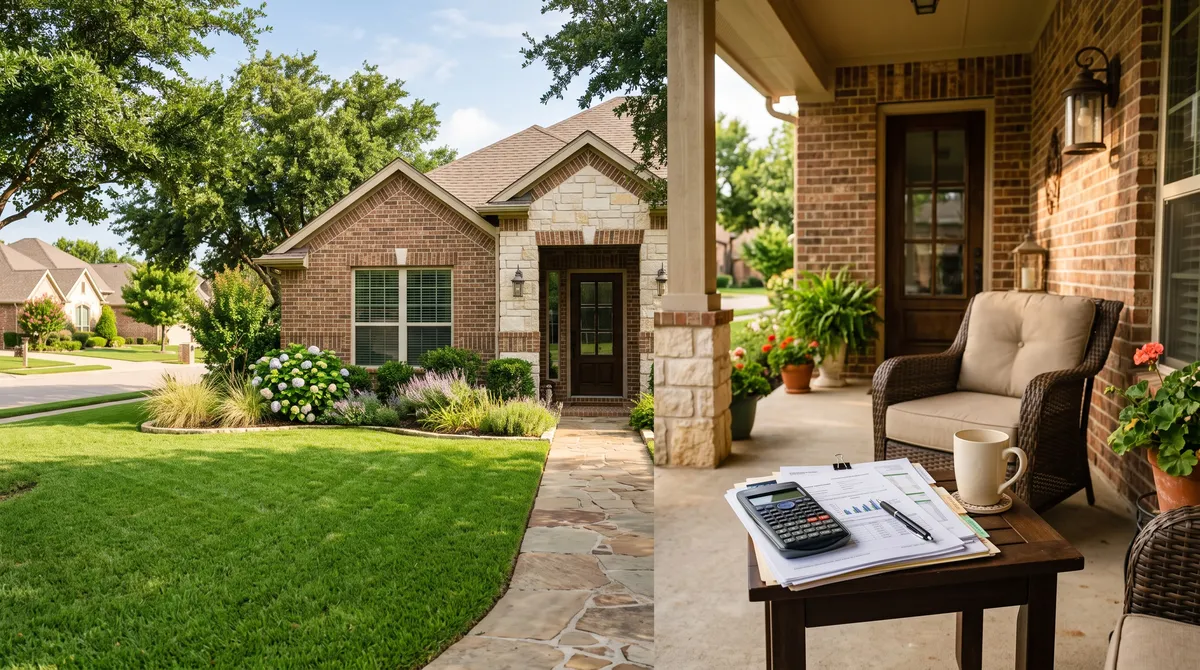
A $350,000 home in the Dallas, Fort Worth area typically runs about $7,000 to $9,000 a year in property taxes before exemptions, which adds roughly $585 to $750 to your monthly mortgage payment. Most first-time buyers get blindsided by this number because they focus on the home price and forget about the taxes. Texas has no state income tax, and it makes up for it with property taxes well above the national average: the median effective rate in Dallas County sits around 1.7%, while combined nominal rates commonly run 2.0% to 2.7%.
Here’s what makes this manageable: understanding how much property taxes are in the Dallas, Fort Worth area becomes straightforward once you know the three key components. Dallas County publishes official tax rates and a helpful tax calculator to estimate your exact bill based on your target neighborhood and home value. Plus, exemptions like the homestead exemption can save you hundreds or even thousands of dollars each year once you know how to apply them.
I break down these calculations during our free consultation, with no surprises, just clear numbers you can count on from Dallas County official sources. Ready to get the real numbers for your dream neighborhood?
Dallas County Property Tax Rates and Averages: What To Expect In 2026
Getting a handle on 2026 rates means no surprises when you’re ready to make an offer. Here’s what the numbers actually look like and why some neighborhoods cost more than others.
What’s the typical total property tax rate range in Dallas County for 2026?
Here’s the real deal: most Dallas County properties land between about 2.0% and 2.7% when you add up every taxing entity. School districts eat up the biggest chunk, usually 1.0% to 1.3% of that total. Cities tack on another 0.55% to 0.75%, and Dallas County itself adds about 0.22%. The official rate schedules break down exactly which entities hit your specific address, and I always pull these for my buyers.
For a $350,000 home in Dallas, Fort Worth, what am I actually looking at for annual taxes?
Before any exemptions kick in, you’re looking at roughly $7,000 to $9,000 per year. That translates to about $585 to $750 monthly in your escrow account. The county’s tax calculator gives you the exact number for any address you’re considering, and I run these calculations for every property we tour together.
How much do rates vary between Dallas and suburbs like Mesquite or Richardson?
School districts create the biggest swings in your average property taxes in Dallas County. Richardson ISD runs higher than Dallas ISD, while Mesquite ISD tends to be friendlier to your wallet. Richardson’s municipal rate also exceeds Dallas’s, but Garland runs a bit lower. We’re talking $1,000+ difference annually on the same home value between high and low areas.
What changed from 2025 to 2026 that I should know about?
Most taxing units kept rates steady or made small tweaks for 2026. The catch? Property values kept climbing in many neighborhoods, so even with unchanged rates, your bill likely goes up. The state’s calculation rules explain the mechanics, but the bottom line: rising appraisals mean higher taxes for most homeowners.
How do I make sense of all these rate breakdowns when comparing neighborhoods?
Let me break this down for you. M&O pays for day-to-day city services like police and parks, while I&S covers payments on bonds for big projects like new schools. Special assessments from MUDs or PIDs add extra costs in newer developments. I always pull the complete list of taxing entities for each property you’re considering, and these calculations can get tricky when you’re comparing multiple properties. That’s where having someone in your corner makes all the difference.
How Property Taxes Are Calculated, and How To Estimate Yours
When you’re looking at that dream home, the listing price is just the beginning. Here’s how to figure out what you’ll actually pay in property taxes each month. I know this seems complicated, but once you see it broken down for your actual target homes, it becomes much clearer.
What’s the basic formula for calculating your yearly tax bill?
Here’s what I tell my clients: your property tax cost follows a simple formula: what the county says your home is worth × total tax rate = your yearly bill (before exemptions). The total rate combines several entities: Dallas County, your city, school district, and any special districts like water or hospital districts. Each sets its own rate, and they’re added together, typically landing around 2.0% to 2.7% in Dallas County.
How does the homestead cap work, and when does it protect me?
The homestead cap limits your assessed value increases to 10% per year once you qualify for the homestead exemption. If you buy in March 2026, you’ll qualify for the cap starting January 1, 2027, protecting you from big value jumps in future years. You must live in the home as your primary residence to get this protection.
What would a $400,000 home actually cost me each year?
Let’s put some real numbers on the table. At a typical 2.2% total rate, you’d pay about $8,800 per year before exemptions. Texas raised the standard school-tax homestead exemption to $140,000 for 2026 (voters approved it as Proposition 13), and because it applies only to the school-district portion of your rate (roughly 1.0%), it trims about $1,400 off your annual bill, bringing it down to around $7,400. That breaks down to about $617 per month in your escrow account. Whether you’re looking at a $300,000 starter home or a $500,000 family house, the same formula applies. Just plug in your numbers.
How do I turn this into my actual monthly payment?
Divide your yearly property tax cost by 12 to get your monthly escrow portion. Your lender collects this with your mortgage payment and pays the county twice yearly. Escrow adjustments happen when appraisals jump significantly, or tax rates change, and your lender will recalculate your monthly payment and may require a catch-up payment to cover any shortfall.
Can I trust online property tax calculators for Dallas County?
Most calculators give ballpark estimates, but accuracy depends on current data. This trips up a lot of first-time buyers who get surprised at closing. Use the DCAD property search to find the exact taxing entities for your target home, then apply the latest combined rate. Don’t forget to subtract applicable exemptions. Many calculators miss this step and overestimate what you’ll actually owe. During our free 10-minute consultation, I’ll pull up the exact tax rates for any home you’re considering and walk through the real monthly cost.
How are property taxes split when I close mid-year?
Texas property taxes are due January 31st for the previous year. At closing, the seller pays their portion (January 1st through closing date), and you’re responsible from closing forward. You’ll see this adjustment as a line item on your closing paperwork. Your first full tax bill comes in January after you close.
We’ll cover all the exemptions you can claim and how to apply for them in the next section. Some of these savings are substantial and worth understanding before you buy.
Exemptions, Protests, and Savings: Keeping Your Bill In Check
Here’s the thing most first-time buyers don’t realize: your initial property tax estimate isn’t set in stone. I’ve helped clients slash their yearly tax burden by $2,000-$4,000 through smart exemption strategies and successful protests. Let me show you exactly how to keep more money in your pocket.
What homestead exemption benefits can I get in Dallas County, and when should I apply after closing?
The homestead exemption is your biggest win: it cuts your school-taxable value by up to $140,000, potentially saving you around $1,400 to $1,700 a year on a typical home. You can apply as soon as you own and occupy the property, and you can even file up to two years after the delinquency date if you miss the first window. Aim to submit that paperwork by April 30th to lock in savings for the current tax year.
Which other property tax exemptions does Dallas, Fort Worth, TX offer, and can I stack them with a homestead?
Additional breaks include an extra $60,000 school-tax reduction for age 65+ or disabled homeowners (bringing the combined school exemption to $200,000), plus a 100% exemption for totally disabled veterans. These stack beautifully with a homestead. I’ve seen clients combine them for $3,000+ in annual savings. You can’t claim both age 65 and disability simultaneously, but you’ll need different paperwork for each one anyway.
What are the protest deadlines, and what actually works to win?
Protest deadlines hit May 15th or 30 days after your notice arrives, whichever is later. Miss this, and you’re stuck for the year. Submit your challenge online through DCAD’s system with comparable sales, photos of property issues, or evidence that they overvalued your home. A large share of protests, often more than half, result in reductions, and most settle without formal hearings.
How does new construction mess with my first-year tax bill?
New construction gets appraised at completion, creating a mid-year jump that catches buyers off guard. Your first full tax year might run $200-500 monthly higher than closing estimates showed. Budget for the complete appraised value, not the construction-in-progress amount. I walk every client through this, so there are no surprises.
How do exemptions and successful protests affect my monthly mortgage payment?
Every dollar you save on yearly taxes reduces your required escrow contributions. Your lender recalculates annually and either refunds overpayments or drops your monthly amount. Successful protests can generate refunds for overpaid taxes from previous years, and I’ve seen clients get $1,200+ checks.
Can I transfer exemption benefits when moving within Texas?
Age 65+ and disabled homeowners can transfer their tax ceiling to a new home of equal or lesser value anywhere in Texas. Get that transfer paperwork submitted to your new county’s appraisal district before the deadline. A regular homestead doesn’t transfer, but you can apply immediately at your new address.
Want to see exactly what exemptions you qualify for and how much you’ll save? I guarantee we’ll find every dollar of savings available, or I’ll write you a check for $100. Call any of my recent clients and ask if I actually deliver on that promise, then let’s get your taxes optimized from day one.
Dallas vs. Fort Worth (and Ellis County): Which Areas Tend To Cost Less?
When you’re weighing neighborhoods, property tax differences can swing your monthly payment by $200-400, even between similarly priced homes. Here’s how to spot the real costs across Dallas, Fort Worth, and Ellis County areas, because nobody wants tax bill surprises after closing.
How do Dallas County rates compare with Tarrant County and Ellis County overall?
Let me put this plainly: on an effective basis, what owners actually pay after exemptions, Dallas County averages around 1.7%, Tarrant County (Fort Worth area) about 1.5%, and Ellis County the lowest at roughly 1.2%. Combined nominal rates run higher across all three, generally 2.0% to 2.7%. The differences come from varying school district needs, municipal services, and debt obligations across counties. SmartAsset’s effective rates are a handy starting point for current-year comparisons.
Which suburbs tend to have lower effective tax burdens after exemptions?
Suburbs in Ellis County, like Midlothian and Waxahachie, often show lower effective rates. In Tarrant County, areas served by smaller school districts cost less than Fort Worth ISD. Within Dallas County, some northern suburbs benefit from lower municipal rates. The Dallas Central Appraisal District shows exact breakdowns by tax district.
How do special districts in new developments affect total costs?
MUDs (Municipal Utility Districts) and PIDs (Public Improvement Districts) can add 0.3-0.8% to your total rate in newer neighborhoods. These districts fund infrastructure like roads, water systems, and landscaping. Established neighborhoods rarely have these extra charges. Always ask about special districts when comparing new construction versus older homes. This is where I help clients avoid costly oversights.
What tax trade-offs exist between different school districts?
Higher-rated school districts like Plano or Highland Park ISD charge more in taxes but offer premium amenities and test scores. Dallas ISD rates vary widely by area. Smaller districts often provide good value with moderate rates. When you compare Dallas vs Fort Worth property taxes, weigh school quality against the extra cost for your family’s specific needs.
How can I accurately compare two specific homes I’m considering?
Look up each property on the respective county appraisal district website to see exact tax districts and the last appraised values. Calculate the total rate by adding county, city, school district, and any special district rates. Apply exemptions to get your true effective rate. This apples-to-apples approach reveals the real monthly difference, though I know this can feel overwhelming for first-time buyers.
Coming from out-of-state, what should I budget for Texas property taxes?
Texas property taxes usually run about 1.5% to 2.5% of home value annually on an effective basis, which often feels high compared to states with income tax. However, Texas has no state income tax, which can offset the property tax burden depending on your income level. Budget around 2.0% to 2.7% of the purchase price as a starting point for the Dallas, Fort Worth area, before exemptions bring it down.
Next Steps: Get A Personalized Dallas, Fort Worth Property Tax Estimate And Buying Plan
Property taxes in the Dallas, Fort Worth area generally range from about 2.0% to 2.7% of your home’s value in combined nominal rates (roughly 1.7% on an effective basis after exemptions), but your actual bill depends on your specific neighborhood, school district, and available exemptions. The tax calculator from Dallas CAD can give you rough estimates, but nothing beats having someone walk through real numbers with you before you start touring homes. That’s where personalized guidance makes all the difference.
Here’s what I do differently: bring me two addresses you’re considering, and I’ll create side-by-side tax comparisons that include exemptions, special districts, and realistic monthly payment impacts. During our free 10-minute Initial Consultation, you’ll get a custom breakdown that helps you estimate your Dallas, Fort Worth property taxes with confidence, plus we’ll map out your entire buying strategy.
You get the paid home inspection ($600), $500 moving credit, earnest money protection, and a cancel-anytime policy. Want to verify I’m legit first? I’ll connect you with recent clients who bought in Dallas, Fort Worth, or Ellis County. Ask them anything about the process.
Book your free consultation here and let’s get you clear on what homeownership will actually cost each month.
Related Articles

Closing Costs in Fort Worth, Texas: What Buyers Pay
Buyer closing costs in Fort Worth run 3% to 5% of the price. The line items one at a time on the median, who pays what in Texas, and how to cut the number.
Down Payment Assistance in Texas: HAP, TSAHC, TDHCA
Texas down payment assistance is not free money. Most of it is priced into your interest rate. The real math on HAP, TSAHC, and My First Texas Home.

FHA vs. Conventional Loan in Texas: Which Is Better?
FHA or conventional in Texas? Compare 2026 down payments, credit minimums, MIP vs PMI, and Tarrant County loan limits with real Fort Worth payment math.